
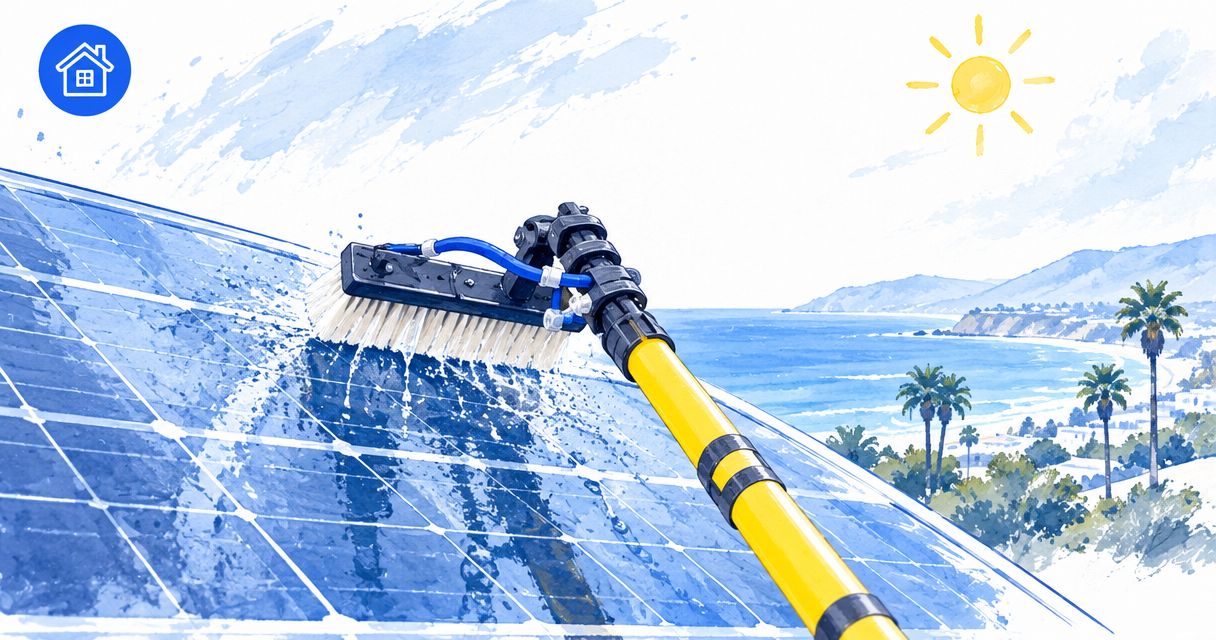
Best overall: manufacturer-approved soft-brush cleaning from stable ground, where the array is safely reachable. Best for light, loose dust: a gentle ground-based rinse. Best no-access option: leaving the array alone until safe cleaning is arranged. This 2026 guide ranks solar panel cleaning methods for Ventura homes by access risk, panel contact, and the manufacturer's instructions.
- Solar panel cleaning methods ranked by safety Ventura: ground-based, manufacturer-approved cleaning comes first when access permits.
- Lavarecleans provides solar panel cleaning for Ventura homeowners; request a free in-person quote to discuss access.
- Rain avoids cleaning-related contact but does not reliably remove every deposit.
- Skip pressure washing and abrasive scrubbing unless the module manufacturer explicitly permits the proposed method.
Why this matters
A clean panel is not worth a roof fall or damaged equipment. Start with how someone will reach the array, not which brush they plan to use. A gentle tool does not make unsafe access acceptable.
Ventura homeowners face different cleaning conditions, from coastal salt film to windblown dust. Those deposits do not justify stronger pressure or harder scrubbing. The panel manufacturer's care instructions set the limits.
Lavarecleans is a local solar panel cleaning option for Ventura homeowners who want a free in-person quote. Lavarecleans also serves Santa Barbara, Montecito, and Ojai. Describe the array's location when requesting your quote so the conversation starts with access.
What makes the safest solar panel cleaning method?
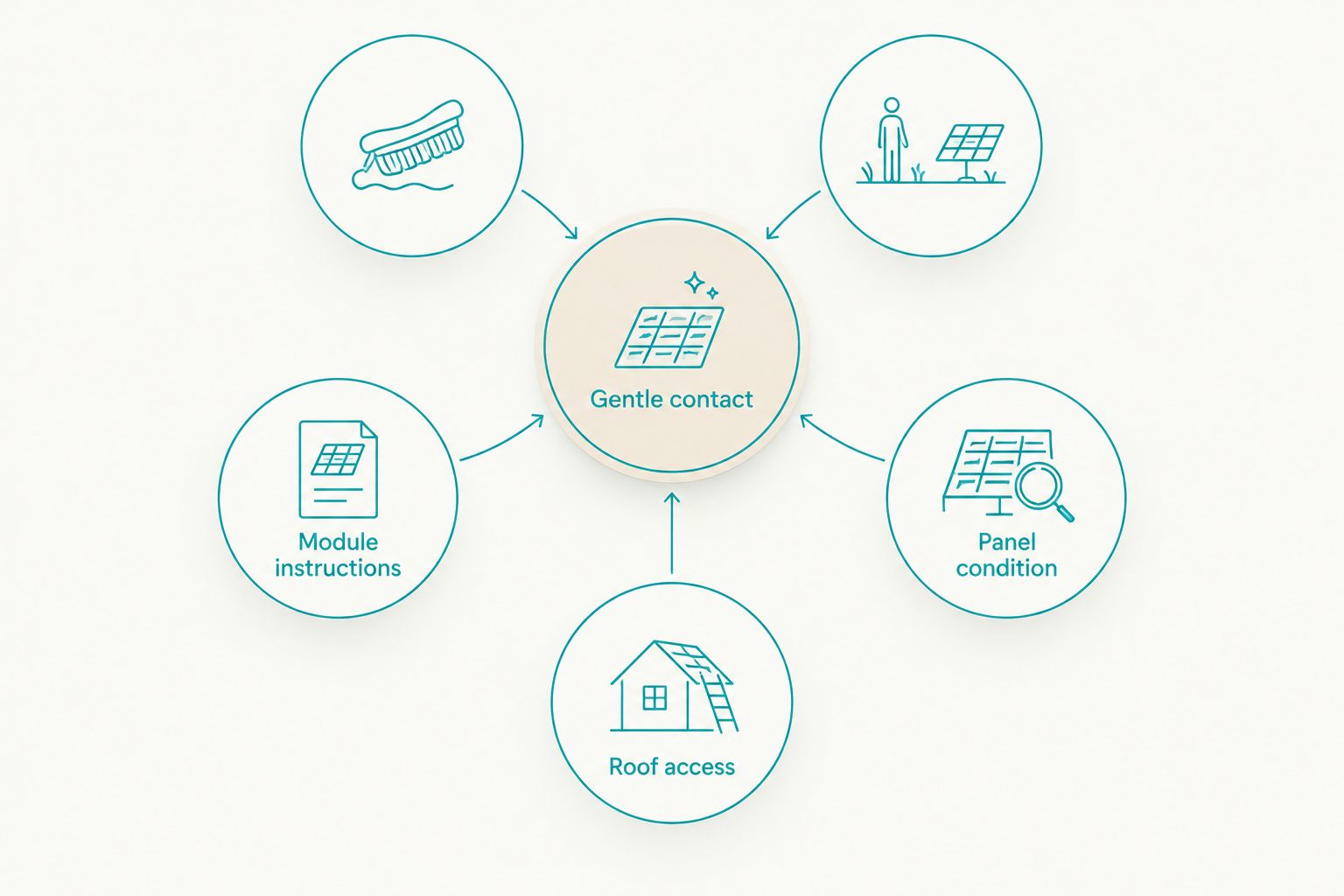
Use these criteria when comparing methods for your 2026 cleaning plan:
- Ground access: Favor work from stable ground when the entire array can be reached without unsafe stretching or nearby electrical hazards.
- Module instructions: Match the tools, water application, and any cleaning agent to the instructions for your specific panels.
- Panel condition: Stop when you see cracked glass, exposed wiring, or other damage. Cleaning is not an electrical repair.
- Gentle contact: Favor an approved soft brush and controlled water application over abrasion or concentrated force.
- Roof access: If ground access is inadequate, require a separate assessment of roof condition, footing, and fall protection.
These criteria work together. A soft brush on an unstable ladder does not outrank a carefully planned professional approach simply because the bristles are gentle.
Solar panel cleaning methods at a glance
This ranking compares cleaning approaches, not service providers. Ground-based methods rank first only when the operator can reach and control the equipment safely.
| Rank | Method | Best for | Main safety advantage | Key limitation |
|---|---|---|---|---|
| 1 | Approved soft brush from the ground | Reachable arrays with deposits needing gentle contact | Avoids roof walking | Pole reach and control limit suitability |
| 2 | Gentle rinse from the ground | Loose surface dust | Avoids brushing and roof access | Does not reliably remove attached deposits |
| 3 | Professional cleaning with planned roof access | Arrays beyond safe ground reach | Allows access to otherwise unreachable panels | Introduces work-at-height hazards |
| 4 | Rain and observation | Avoiding unnecessary intervention | Requires no cleaning access | Weather is not a controlled cleaning method |
| 5 | Pressure washing or abrasive scrubbing | Recognizing methods to reject | No general safety advantage | Risks damage and conflicts with many care instructions |
1. Approved soft brush: best for safely reachable arrays
A manufacturer-approved soft brush can loosen deposits without relying on concentrated water pressure. Used from stable ground, the method also avoids walking on the roof. It ranks first when the operator can reach the panels, control the brush, and follow the module instructions.
The word approved matters. A brush sold for general exterior cleaning is not automatically suitable for every panel surface. Dirt trapped in a brush also needs attention before that brush touches the glass.
Approved soft-brush cleaning pros:
- Combines gentle contact with controlled rinsing.
- Avoids roof walking when ground access is suitable.
- Gives the operator a way to address deposits that a rinse leaves behind.
Approved soft-brush cleaning cons:
- Long reach can make brush placement difficult to control.
- Roof edges and panel layout can leave sections unreachable.
- Unsuitable or contaminated bristles can scratch surfaces.
Best for: Homeowners whose arrays are safely reachable from stable ground and whose panel instructions permit brushing.
Ask how the operator will reach the upper edge without resting equipment on the array. If the answer requires overreaching, change the access plan rather than forcing the method.
Verdict: Buy this approach when safe reach and manufacturer approval are confirmed.
2. Gentle ground-based rinse: best for loose dust
A gentle rinse uses water without deliberate brush contact. It suits loose material that releases without scrubbing, provided the panel manufacturer permits the proposed water application.
Rinsing is not a complete answer to every deposit. Bird droppings and attached grime can remain after the surrounding dust washes away. Increasing pressure to compensate changes the method and its risks.
Gentle-rinse pros:
- Avoids direct brush contact with the panel surface.
- Avoids roof access when the array is safely reachable.
- Offers a simple option for loose surface material.
Gentle-rinse cons:
- Attached deposits can remain after rinsing.
- Dissolved minerals in water can leave residue as it dries.
- Overspray needs control around electrical components and surrounding surfaces.
Best for: Reachable panels with light, loose dust and no visible damage.
For a 2026 maintenance visit, ask what water the cleaner intends to use and how runoff will be managed. Water quality matters, but it does not replace safe access or the panel manufacturer's instructions.
Verdict: Buy for loose dust; hold if the job needs stronger contact or unsafe reach.
3. Planned professional roof access: best for unreachable arrays
Some arrays cannot be cleaned effectively from the ground. Professional roof access is a separate access decision, not simply the next step after buying a longer pole. Roof condition, pitch, edges, equipment placement, and electrical hazards all need assessment.
For a 1-story home or a 2-story home, height alone does not settle the question. A lower roof can still have fragile surfaces or poor footing. The cleaning plan must suit the actual property.
Professional roof-access pros:
- Provides access where ground-based equipment cannot reach safely.
- Allows a suitable cleaning method to reach the full array.
- Supports closer assessment of visible obstructions before cleaning proceeds.
Professional roof-access cons:
- Adds fall hazards that ground-based work avoids.
- Requires appropriate access equipment and protection.
- Creates opportunities to damage roofing if movement is poorly planned.
Best for: Arrays that genuinely require roof access after a property-specific assessment.
Ask whether the work requires stepping near the panels, how equipment will be secured, and how the roof will be protected. Never accept walking on solar modules as a routine cleaning technique.
Use the guide to choosing a nearby solar panel cleaning service to prepare your questions before accepting a quote.
Verdict: Hold until a qualified provider explains the access and protection plan.
4. Rain and observation: best for avoiding unnecessary intervention
Rain requires no ladder, brush, or roof access. If the alternative is an unsafe attempt to reach the array, leaving the panels alone is the safer choice for the homeowner.
That does not make rain a dependable cleaning service. Rain can move loose dirt, but it does not reliably remove attached deposits. Observation means checking from a safe location, not climbing up to inspect the glass.
Rain and observation pros:
- Avoids cleaning-related roof access.
- Avoids introducing brushes or cleaning agents.
- Gives you time to arrange an appropriate assessment.
Rain and observation cons:
- Offers no control over timing or cleaning coverage.
- Leaves some deposits behind.
- Does not establish whether a performance concern comes from dirt or another issue.
Best for: Homeowners who cannot safely reach the array and have not yet arranged professional help.
For your 2026 maintenance plan, treat rain as weather rather than a guaranteed cleaning result. If output concerns continue, ask the installer about diagnosis instead of assuming the glass needs more aggressive cleaning.
Verdict: Wait safely when access is unresolved; do not count rain as a complete cleaning method.
5. Pressure washing or abrasive scrubbing: best left out
Pressure washing and abrasive scrubbing attempt to remove deposits through force. Neither belongs in a default residential solar panel cleaning plan. Panel glass, coatings, seals, and electrical components need treatment consistent with the manufacturer's directions.
A tool appropriate for a driveway is not automatically appropriate for solar equipment. The fact that both surfaces are outdoors says nothing about their cleaning requirements.
Force-based cleaning pros:
- Can dislodge stubborn material from surfaces designed for that treatment.
- Has valid uses elsewhere in exterior cleaning when the surface permits it.
- Makes the need for surface-specific instructions clear.
Force-based cleaning cons:
- Concentrated pressure can damage vulnerable components or introduce water where it does not belong.
- Abrasives can damage glass surfaces or coatings.
- More force does not solve an unsafe access problem.
Best for: Identifying an approach to reject unless the module manufacturer explicitly permits the exact equipment and procedure.
Do not test a pressure washer or scraper on a small panel area to see what happens. An inconspicuous spot is still part of the equipment.
Verdict: Skip as a general solar panel cleaning method.
How the methods rank
This safety order prioritizes avoiding roof exposure, following module instructions, and limiting unnecessary force. It is a decision guide, not a report of timed trials or measured cleaning results.
Ground-based soft-brush cleaning takes the default position because it combines controlled contact with the possibility of avoiding roof access. A gentle rinse ranks next because it limits contact but handles fewer deposit types. Roof access adds hazards; rain offers limited cleaning control; force-based methods introduce avoidable risks.
A property's conditions can rule out the first option. The safest suitable method beats the highest-ranked unsuitable method.
Which method should you choose in Ventura?
Start your 2026 decision with the panel model and a view of the array from stable ground. Identify whether the issue is loose dust, attached deposits, or an unexplained output change. Do not climb onto the roof to gather that information.
Choose manufacturer-approved ground-based soft-brush cleaning when reach and control are suitable. Choose a gentle rinse only when the deposit and instructions support it. When neither works safely, request a professional access assessment.
Lavarecleans provides solar panel cleaning alongside window cleaning, gutter cleaning, pressure washing, and holiday lighting. Ask the local crew to explain the proposed work and access before booking. If you are unhappy with the work, Lavarecleans promises to return and make it right.
Request a free in-person quote
Discuss your Ventura property's solar panel access and proposed cleaning approach.
FAQ
What's the safest solar panel cleaning method for a Ventura home?
Manufacturer-approved cleaning from stable ground is the preferred starting point when the array is safely reachable. An approved soft brush with controlled water application suits deposits needing contact; unsafe reach rules that approach out.
Is a water-fed pole safer than climbing onto the roof?
A water-fed pole avoids roof access when the operator can use it safely from stable ground. Excessive reach, poor control, and nearby electrical hazards still need assessment.
Can I pressure wash my solar panels?
Do not use pressure washing as the default method for solar panels. Follow the module manufacturer's instructions, and reject any proposed equipment or procedure those instructions do not permit.
Does rain replace solar panel cleaning in Ventura?
Rain does not reliably replace solar panel cleaning. It can move loose material, but attached deposits can remain, and rainfall does not provide controlled coverage.
Should solar panels be switched off before cleaning?
Follow the system manufacturer's shutdown and cleaning instructions. A shutdown does not make every component electrically safe, because panels exposed to light can still generate electricity.
Can I clean cracked solar panels?
Do not clean visibly cracked panels or panels with exposed wiring. Keep clear and contact the installer or a qualified solar professional for assessment.
How do I get a solar panel cleaning quote in Ventura?
Request a free in-person quote from Lavarecleans and describe where the array sits. Ask which cleaning method is proposed, whether roof access is required, and how the method follows your panel manufacturer's instructions.
One last thing
A lower production reading is not proof that dirt is the cause. Shade, equipment faults, and other system conditions also affect output. If cleaning becomes the answer to every performance concern, pause and ask your installer what the system data actually shows.
For 2026, keep the panel care instructions with your service records. That document is more useful than a promise that one cleaning method works on every roof.