
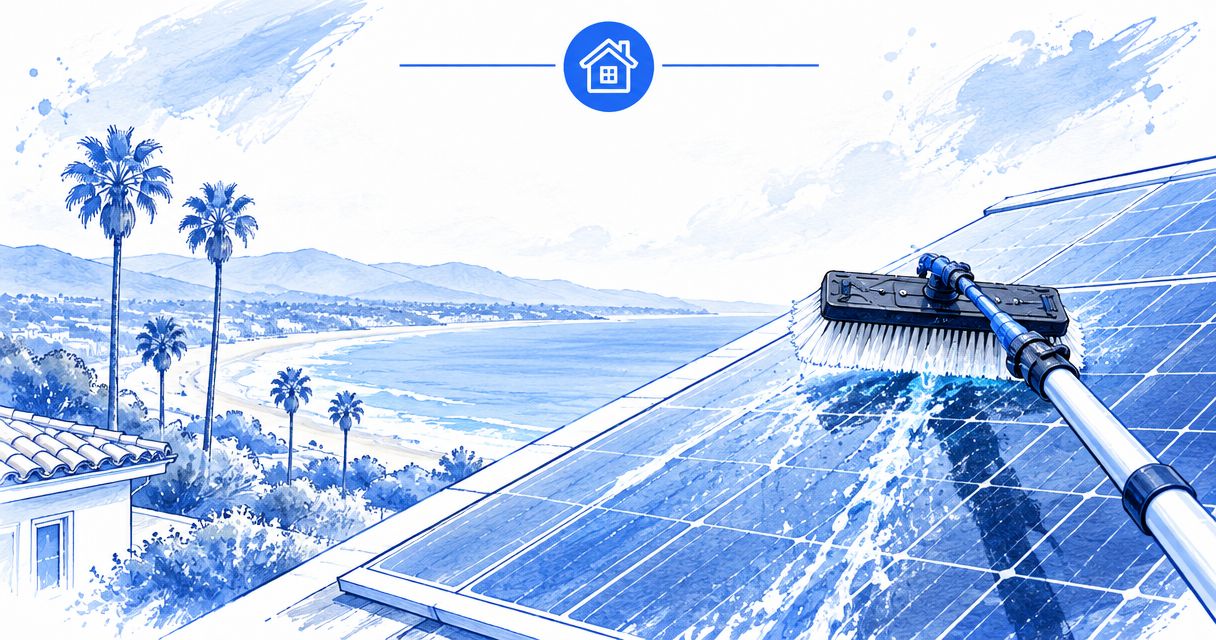
Best overall: a manufacturer-approved soft brush with a purified-water rinse. Best for loose dust: a gentle rinse where the panel instructions permit it. Best for stubborn deposits: professional spot treatment approved for the specific panels. This 2026 guide compares the best solar panel cleaning methods Santa Barbara homeowners can choose without treating rooftop glass like a driveway.
- Best solar panel cleaning methods Santa Barbara: choose manufacturer-approved soft brushing and purified water for attached surface dirt.
- A gentle rinse suits loose dust, not every salt deposit or bird dropping.
- Lavarecleans provides solar panel cleaning for homeowners in Santa Barbara, Montecito, Ojai and Ventura.
- Keep roof access and deposit removal separate: the right cleaning method still needs a safe working position.
Why this matters
Coastal salt film and hillside dust present different cleaning problems. Loose particles need less intervention than dirt that remains attached after wetting. Choosing a stronger tool before identifying the deposit adds risk without answering the real question: what does your panel manufacturer allow?
Lavarecleans solar panel cleaning is for homeowners in Santa Barbara, Montecito, Ojai and Ventura who want local service rather than rooftop DIY. You can request a free in-person quote through Lavarecleans. Ask which method suits your panels and how the crew will reach them.
For your 2026 maintenance plan, start with condition and access—not a promise of a particular production increase. Cleaning cannot correct shade, equipment faults or every cause of lower output.
What makes the best solar panel cleaning method?
Judge these 4 methods against the same criteria before choosing one:
- Manufacturer approval: The module's care instructions take priority over general cleaning advice, including advice about brushes, chemicals and water application.
- Deposit match: Loose dust, salt film, bird droppings and mineral marks do not all respond to the same treatment.
- Water quality: Dissolved minerals can remain when water evaporates. Purified water addresses that source of residue; it does not automatically remove existing deposits.
- Gentle contact: Cleaning should remove dirt without abrasive pads, scraping or unnecessary force against the glass and its surface treatments.
- Safe access: A suitable brush does not make an unsafe ladder position or roof walk acceptable.
- Clear limits: A credible recommendation explains what the method will not remove and when the work should stop.
Solar panel cleaning methods at a glance
| Method | Best for | Standout feature | Key limitation |
|---|---|---|---|
| Approved soft brush and purified-water rinse | Attached surface dirt | Gentle agitation followed by a low-mineral rinse | Requires compatible equipment and safe reach |
| Gentle water rinse | Loose surface dust | Removes loose material without brush contact | Does not reliably resolve attached deposits |
| Approved professional spot treatment | Persistent localized marks | Matches treatment to a specific deposit | Product compatibility must be checked first |
| Rain between cleanings | Passive removal of some loose dirt | Requires no homeowner intervention | Not a controlled cleaning method |
These options are not interchangeable packages. A professional cleaning can combine rinsing, gentle brushing and localized treatment when the panel instructions permit each step.
1. Soft brushing: best for attached surface dirt
A suitable soft brush loosens dirt while water carries it away. A purified-water rinse reduces the dissolved minerals introduced by the rinse itself. Together, those steps address surface dirt without relying on aggressive pressure.
This is the default to discuss when coastal film or settled hillside dust remains on the glass. The recommendation depends on the panel manufacturer's instructions—not on whether a brush is marketed as suitable for solar panels.
Soft-brushing pros:
- Adds gentle agitation when water alone leaves dirt behind.
- Allows attention to visibly dirty areas rather than indiscriminate scrubbing.
- Pairs cleaning with a rinse that introduces fewer dissolved minerals.
Soft-brushing cons:
- A contaminated or unsuitable brush can damage the surface.
- A pole does not guarantee that every roof layout is safely reachable.
- Existing mineral deposits can remain after ordinary cleaning.
Best for: Homeowners with attached surface dirt who want a method selected around their panel instructions and access conditions.
For a 2026 quote, ask whether the proposed brush is compatible with your modules and whether the rinse water is treated. Do not assume either detail from the phrase solar panel cleaning.
Verdict: Buy this approach when the manufacturer permits it and safe access is established.
2. Gentle rinsing: best for loose dust
A gentle rinse uses water to carry away loose particles without brushing. It is the simplest active option here, but simplicity does not make it suitable for every array or every deposit.
Check the manufacturer's water-temperature, pressure and cleaning instructions first. Do not direct water at damaged equipment, exposed connections or other electrical components.
Gentle-rinsing pros:
- Avoids unnecessary brush contact when dirt is already loose.
- Makes sense as an initial step before deciding whether agitation is needed.
- Does not require adding a cleaning chemical where water is sufficient.
Gentle-rinsing cons:
- Attached film and dried bird droppings can remain.
- Mineral-bearing water can leave residue as it dries.
- Reaching the array can still make a seemingly simple task unsafe.
Best for: Loose dust on an array that can be reached safely and whose instructions permit rinsing.
Avoid escalating from a hose to a pressure washer because a mark remains. That changes the method before you have identified the problem.
Verdict: Buy this approach for loose dust; skip it as the sole answer to attached deposits.
3. Approved spot treatment: best for persistent localized marks
Spot treatment addresses a particular deposit rather than applying a stronger cleaner across the entire array. The first step is identification: dried organic material and mineral residue require different decisions.
The cleaner or technique must be allowed for the specific panel. A household glass cleaner, acid-based product or abrasive pad is not automatically suitable just because the surface looks like ordinary window glass.
Approved spot-treatment pros:
- Focuses attention on the deposit that ordinary washing leaves behind.
- Avoids treating clean areas unnecessarily.
- Creates a clear stopping point when compatibility is uncertain.
Approved spot-treatment cons:
- A product suitable for one surface is not necessarily suitable for another.
- Surface damage can resemble removable staining.
- Some marks need assessment rather than repeated cleaning attempts.
Best for: Localized deposits that remain after permitted routine cleaning and need a panel-specific decision.
Ask what the mark appears to be, what treatment is proposed and which manufacturer instruction supports it. A clear explanation matters more than a promise that every mark will disappear.
Verdict: Hold until the deposit and an approved treatment are identified.
4. Rain: best for passive removal of some loose dirt
Rain can carry away some loose material, but you cannot control its coverage or inspect the result from the weather forecast. It is a maintenance event, not a substitute for evaluating visible buildup.
The distinction is straightforward: wet glass is not proof of clean glass. The guide to whether rain replaces professional solar panel cleaning explains that decision in more detail.
Rain pros:
- Requires no climbing, brushing or chemical application.
- Can remove some loose particles between planned inspections.
- Gives you a reason to reassess visible dirt after the surface dries.
Rain cons:
- Does not provide controlled removal of attached deposits.
- Cannot confirm whether persistent marks are dirt or damage.
- Does not replace attention to access or equipment condition.
Best for: Passive upkeep between condition checks, not a scheduled response to stubborn dirt.
Do not make your 2026 cleaning decision solely around the next forecast. Inspect what remains afterward from a safe ground-level position.
Verdict: Skip rain as your only cleaning plan when visible buildup remains.
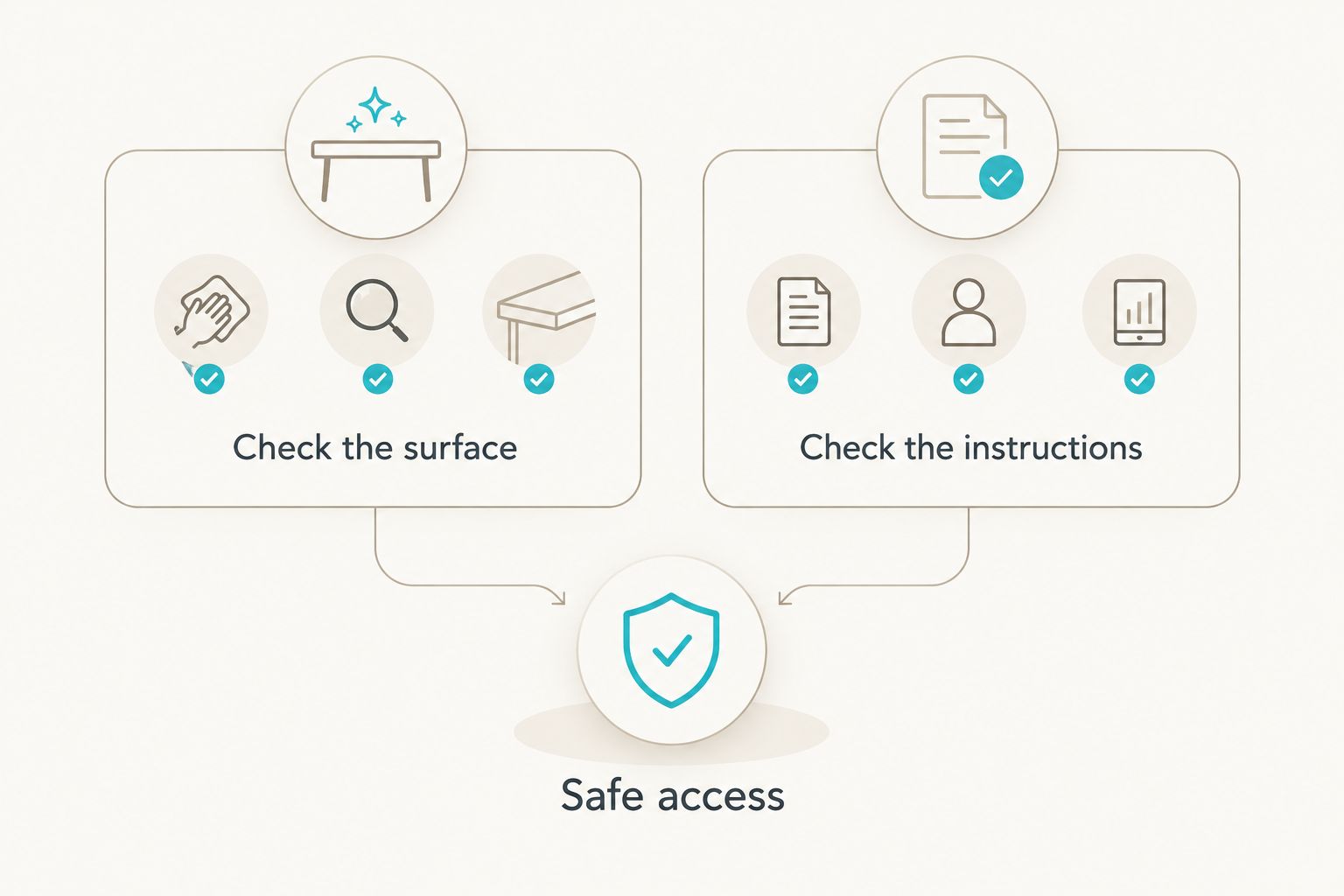
Before cleaning: make 2 ground-level checks
You do not need to climb onto the roof to prepare a useful service request. Gather what you can see and what your system documents already tell you.
Check the surface
Look for the difference between a broad film and isolated marks. Note nearby trees, visible bird activity and whether the condition changed after rain. Photographs taken safely from the ground can help explain the concern, but they cannot establish whether glass or wiring is sound.
Do not touch cracked panels, loose cables or damaged components. Report visible concerns to the installer or an appropriately qualified professional before cleaning proceeds.
Check the instructions
Find the panel make, model and care guidance in your installation paperwork. Share those details when requesting a quote. If the instructions are unclear, resolve the cleaning requirements before choosing tools or chemicals.
A shut-down system is not permission to treat solar equipment as electrically harmless. Panels exposed to light can still generate electricity; follow the system's safety guidance and leave electrical work to qualified professionals.
Hard-water spots need a different decision
Hard-water marks are mineral residue, not simply another layer of loose dust. Repeating a rinse with the same mineral-bearing water does not address the source of new residue. Purified rinse water and treatment of existing marks are separate decisions.
The distinction matters when removing hard water spots: preventing fresh mineral residue is not the same task as removing deposits already attached to panel glass. Any removal method still needs approval for the module surface.
For your 2026 service request, describe where the marks appear and whether sprinklers can reach the panels. Do not diagnose every pale patch as mineral scale. Ask the cleaner to explain the likely cause before accepting stronger treatment.
Stop when the next step requires guessing about compatibility. A persistent mark is a reason to reassess, not a reason to scrub harder.
Ask these 3 questions before accepting a quote
A useful quote explains the work rather than naming a tool. Ask these questions whether you choose Lavarecleans or another provider.
What method fits these panels?
Ask how the proposed cleaning follows your module instructions. The answer should distinguish ordinary surface cleaning from any separate treatment for attached marks. Do not accept a blanket claim that the same chemical or brush suits every installation.
How will the crew reach the array?
Ask whether work can be completed from the ground or whether roof access is proposed. Discuss slopes, landscaping and obstacles that affect positioning. The important answer is the access plan, not a general assurance that the job is routine.
What happens if something remains?
Separate removable dirt from suspected damage before agreeing on the scope. Ask how the result will be checked and how concerns should be reported. Lavarecleans promises to return and make it right if you are unhappy; that is not a promise that every existing mark or equipment issue is removable by cleaning.
Request a free in-person quote
Discuss your solar panels, access and cleaning concerns with a local crew.
How these methods are ranked
The ranking puts manufacturer compatibility, deposit removal and safe access ahead of cleaning strength. Soft brushing with an appropriate rinse is the default for attached surface dirt; rinsing alone serves a narrower purpose. Spot treatment requires more information, while rain remains passive upkeep.
This is a method comparison, not a laboratory performance test. No production gain, cleaning interval or treatment outcome is promised. Your array's condition and instructions determine the final choice.
Which solar panel cleaning method should you choose?
Choose manufacturer-approved gentle cleaning, not the strongest available tool. Start with the least aggressive permitted method that addresses the deposit. Leave roof access and uncertain surface conditions to professionals.
For coastal Santa Barbara homes in 2026, discuss salt film, water quality and the route to the panels during the quote. For hillside properties, describe dust and tree exposure. Those details help define the work without assuming every home needs the same treatment.
FAQ
What's the best solar panel cleaning method for a coastal Santa Barbara home?
A manufacturer-approved soft brush with a purified-water rinse is the default to discuss for attached surface dirt. The final method depends on your panels, the deposits and safe access.
Can I pressure-wash my solar panels?
Do not use a pressure washer unless your panel manufacturer explicitly permits the proposed method. Pressure washing a driveway and cleaning a solar module are different jobs.
Does rain clean salt film off solar panels?
Rain is not a reliable substitute for inspecting and addressing attached salt film. Check what remains after the panels dry, using a safe ground-level view.
Is deionized water enough to remove existing hard-water spots?
Deionized water alone is not a guaranteed treatment for existing mineral deposits. It reduces the dissolved minerals introduced by rinsing; established deposits need separate assessment.
Can I use dish soap or window cleaner on solar panels?
Use a cleaner only when your panel manufacturer's instructions permit it. A product suitable for household windows is not automatically suitable for solar-module surfaces.
How often should I clean solar panels near the coast?
Set cleaning around the manufacturer's guidance and observed buildup rather than an unsupported universal schedule. Salt exposure, dust, birds and nearby trees all belong in the assessment.
Does cleaning guarantee more electricity from my solar panels?
Cleaning does not guarantee a particular production increase. Output also depends on conditions and system performance, so unexplained changes deserve attention beyond washing.
Can I request a local solar panel cleaning quote?
Lavarecleans provides solar panel cleaning for homeowners in Santa Barbara, Montecito, Ojai and Ventura. Request a free in-person quote to discuss the condition, access and proposed work.
One last thing
Do not use shininess as your only inspection standard. Ask what was removed, what remains and whether any mark needs a different assessment. A clear explanation is more useful than another round of unnecessary scrubbing.
Keep window cleaning on its own year-round plan, too. Coastal film on windows and buildup on solar panels can prompt the same service conversation, but each surface needs its own method.