
Rain does not reliably replace professional solar panel cleaning: it can rinse away loose dust, but attached bird droppings, coastal salt film and other residue can remain. For your 2026 maintenance plan, judge the panels by what remains after the rain—not simply by whether it rained—and remember that cleaning cannot correct shade, equipment faults or every drop in electricity production.
- Rain rinses loose dust but does not reliably remove attached residue from solar panels.
- For solar panel cleaning near me, choose a provider who explains access, methods and manufacturer guidance.
- Lavarecleans serves homeowners seeking local solar panel cleaning in Santa Barbara, Montecito, Ojai and Ventura.
- Check panels from the ground; leave roof access and electrical concerns to qualified professionals.
Does rain replace professional solar panel cleaning?
Rain is a rinse, not proof that your solar panels are clean. A shower can move loose material off the glass, while attached deposits remain. The useful question is whether the rain removed the contamination actually sitting on your panels.
Rain and a professional visit also do different jobs. Rain falls without checking the surface, choosing a suitable method or planning safe access; a cleaning provider should explain those decisions before work begins. Use this guide to choose a nearby solar panel cleaning service when residue remains.
| Option | Best for | What it does | Limitation |
|---|---|---|---|
| Rain alone | Rinsing loose surface dust | Carries away some material as water drains | Does not reliably remove attached deposits or confirm cleanliness |
| Ground-level observation | Deciding whether to request an assessment | Reveals visible patches, streaks and obvious debris | Cannot show every part of a roof-mounted array |
| Professional cleaning | Addressing residue that remains after rain | Provides deliberate cleaning with an agreed method and access plan | Does not repair electrical faults or guarantee an output increase |
Professional cleaning is not automatically necessary after every shower or dry spell. If the accessible view shows no persistent contamination and the system has no unexplained performance concern, rain alone is not a reason to book—or cancel—a cleaning visit.
Why this matters
For homeowners in Santa Barbara and Ventura, coastal salt film can make the difference between a surface that looks rinsed and one that still carries residue. Inland dust and material from nearby trees create different cleaning questions. The deposit matters more than a general claim that rain always cleans panels.
Keep your 2026 maintenance decisions tied to the condition of your own array. A neighbor's roof has different exposure, drainage and access, even when the homes share a street. Copying the neighbor's schedule is less useful than checking what persists on your glass.
There is also a limit to what cleaning can accomplish. Dirty glass and a system fault are separate problems. Treat a cleaning quote as a proposal to remove contamination, not as a diagnosis of the entire solar installation.
Rain alone: useful for loose dust
Rain can help when the main issue is a light layer of loose material. Water running down the panel surface carries some of that material with it. You do not need to assume every dusty-looking array requires immediate attention before the next storm.
The limitation is attachment. A deposit that adheres to the glass does not necessarily release just because water passes over it. Light rain can also leave a different result from sustained runoff, so the fact that a weather report recorded rain tells you little about the finished surface.
Best for: allowing ordinary rainfall to rinse loose dust while you observe the result safely. The advantage is that it requires no roof access or cleaning equipment; the drawback is that you cannot control where the water goes or what remains afterward.
Do not turn that observation into a roof inspection. Look from an accessible position on the ground. If the roof angle hides the panels, tell the provider rather than trying to reach a better viewpoint.
Professional cleaning: useful when residue persists
A professional cleaning visit addresses the material rain leaves behind. The provider should identify the visible contamination, explain the cleaning approach and account for the roof and equipment involved. A useful quote describes the job rather than promising a universal performance result.
Lavarecleans is best for homeowners seeking local solar panel cleaning in Santa Barbara, Montecito, Ojai and Ventura. Its local crew provides exterior cleaning services, and its stated promise is to return and make it right if a customer is unhappy. That service commitment is different from a guarantee of increased electricity production.
Best for: homeowners who see persistent deposits or need a professional assessment because safe access is difficult. The benefit is deliberate cleaning rather than an incidental rinse; the limitation is that cleaning alone does not establish whether the inverter, wiring or other equipment is working correctly.
Ask the provider to keep those boundaries clear. A cleaner should not need to promise a particular energy gain to explain why attached material deserves attention.
Why rain's cleaning effect varies
Rain does not deliver a uniform result across every roof. These factors explain why one array looks clearer afterward while another still needs attention:
- Deposit type. Loose dust and attached bird droppings are different cleaning problems. Water passing over them does not produce the same result.
- Rainfall pattern. A brief wetting and sustained runoff move material differently. Judge the surface afterward rather than relying on the forecast.
- Panel slope. The installation angle affects how water drains across the glass. Areas that retain water or collect material deserve attention during an assessment.
- Local exposure. Coastal salt film, hillside dust and nearby trees influence what lands on the panels. Exposure can differ across the same property.
- Remaining residue. Rain can remove some contamination without removing all of it. Persistent patches matter more than the general impression that the roof got wet.
These factors explain variation; they do not establish a fixed cleaning interval. A provider still needs to understand the actual condition and access requirements before recommending work.
How do you check your panels after rain without climbing?
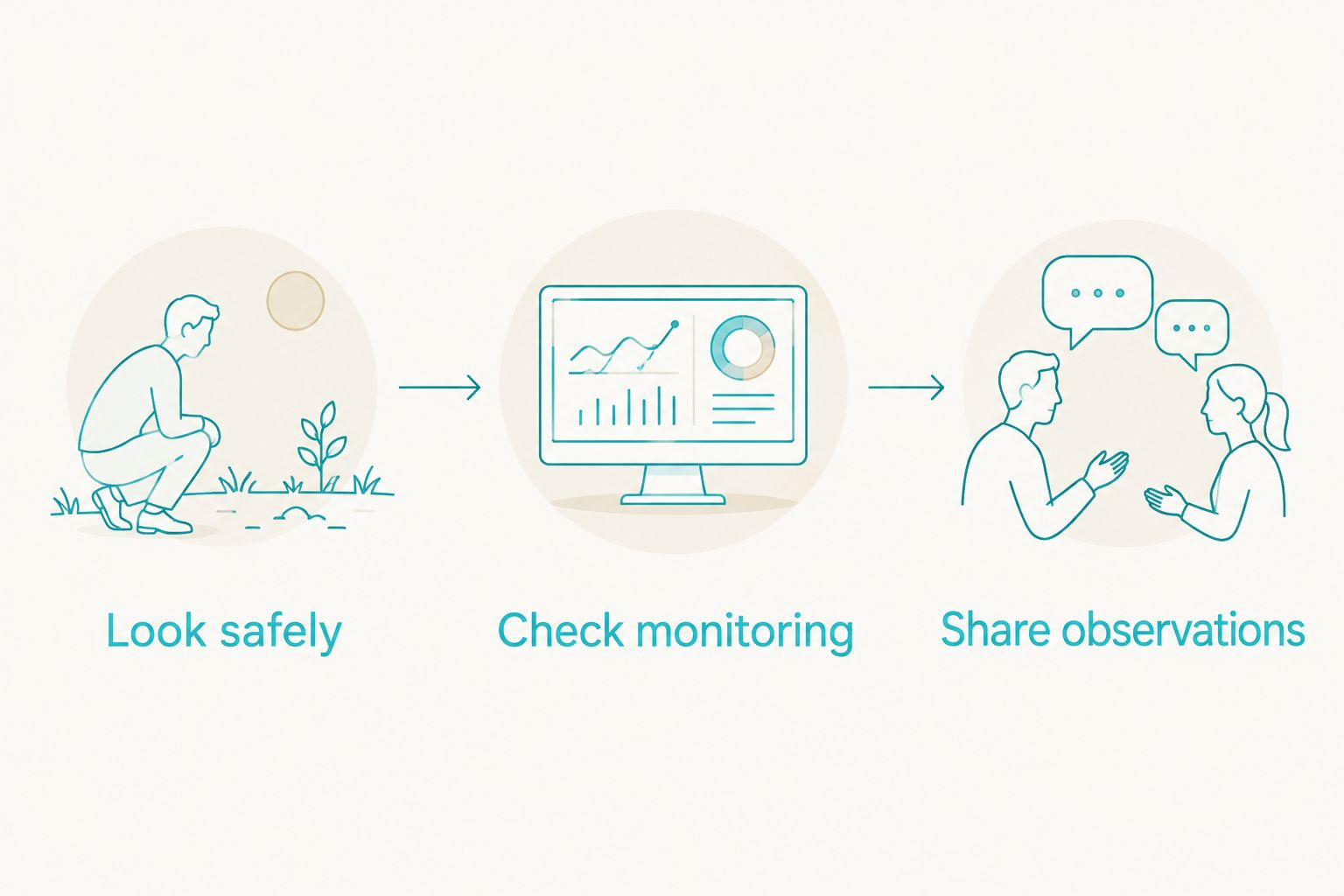
Use these 3 checks for your 2026 maintenance notes. They help you describe the problem without turning a visual check into roof work.
- Look safely. From a stable ground-level position, look for attached patches, streaks or accumulations you can clearly see. Do not climb, lean from a window or step onto a roof to complete the check.
- Check monitoring. Review your system's available monitoring for alerts or an unexplained change. Compare similar conditions where possible; a cloudy day is not a fair comparison with a clear one.
- Share observations. Tell the provider what remains visible, when you noticed it and whether monitoring shows a concern. Include photographs only when you can take them safely.
Monitoring adds context, but it is not a dirt detector. Output changes with sunlight, weather and shade, as well as system condition. If an alert suggests an equipment problem, contact the installer or another appropriately qualified solar professional instead of assuming a wash will solve it.
Can rainwater leave solar panels looking dirty?
Rainwater can move existing dirt into streaks or leave attached material visible after the surrounding surface looks clearer. That appearance does not prove the rain caused damage. It tells you the rinse did not leave a uniformly clean surface.
Avoid diagnosing the deposit from a distant photograph alone. Salt residue, dust and other marks can look similar from the ground. Describe what you see and ask the provider how the material will be assessed before cleaning.
Do not substitute a hose test for that assessment. Household water can leave mineral residue, and reaching roof-mounted panels introduces access and electrical concerns. A wet surface is not evidence that a suitable cleaning process has been used.
Should you book cleaning before or after rain?
Book around the condition of the panels and safe working conditions, not a blanket rule about rain. If loose dust is the only visible issue and rain is imminent, checking the result afterward gives you more useful information. Attached contamination calls for a different discussion.
Tell the provider about the forecast when arranging work. Let the crew assess whether conditions suit the access plan and cleaning method. Do not assume a scheduled visit should proceed simply because you want the panels ready before a clear day.
For your 2026 calendar, use reminders to inspect from the ground rather than treating every reminder as an automatic cleaning appointment. Record persistent residue and ask for advice when the condition changes.
What should you ask a local solar panel cleaner?
When you search for solar panel cleaning near me, proximity is only the starting point. You also need a provider who can explain how the work fits your installation. Clear answers matter more than a promise that every panel will produce more power afterward.
Ask these questions before accepting a 2026 quote:
- What is included? Confirm which panels and surfaces the quote covers. Do not assume adjacent skylights, gutters or windows are included.
- How will you reach the array? Ask how roof height, slope and access restrictions affect the work. Do not request a method that requires unsafe access.
- What cleaning method is proposed? Ask about water, tools and any cleaning agents, including how the method follows applicable manufacturer instructions.
- What happens if damage is noticed? Agree that visible damage or equipment concerns should be reported, not treated as ordinary dirt.
- How will the result be checked? Ask how the provider will confirm that the agreed cleaning work is complete, especially where panels are difficult to see.
For local solar panel cleaning, Lavarecleans offers a free in-person quote. Use that visit to discuss visible residue, access and the work you want included. An in-person conversation is also a practical time to identify nearby windows or other exterior surfaces that need separate attention.
Request an in-person quote
Discuss solar panel residue, roof access and the cleaning work your home needs.
Can you combine solar panel and window cleaning?
You can ask about both services during the same quote, but keep the scope separate. Solar panels and windows are different surfaces with different access and equipment considerations. A method proposed for one is not automatically suitable for the other.
Lavarecleans provides window cleaning year-round, alongside solar panel, gutter and pressure-washing services. If coastal film is visible on your windows as well as your array, describe both concerns. Request clear inclusion of each service rather than assuming an exterior-cleaning visit covers everything.
The same principle applies to seasonal gutter work. Debris around the roofline is worth mentioning, but cleaning gutters is not the same task as cleaning solar glass. A clear scope prevents confusion about what the crew will address.
FAQ
Does heavy rain clean solar panels well enough?
Heavy rain can rinse loose material, but it does not guarantee clean solar panels. Check for attached deposits afterward from a safe ground-level position.
Should I search for solar panel cleaning near me after every storm?
You do not need professional cleaning simply because a storm passed. Search for solar panel cleaning near me when residue persists or you need help assessing the array safely.
Will solar panel cleaning always increase my electricity production?
Solar panel cleaning does not guarantee an increase in electricity production. Weather, shade and equipment condition also affect output, so unexplained changes need proper assessment.
Can I clean rooftop solar panels with a garden hose?
A garden hose is not a substitute for an appropriate cleaning and access plan. Household water can leave mineral residue, and roof access introduces safety concerns.
How often should solar panels be professionally cleaned?
A suitable cleaning schedule depends on exposure, visible deposits and manufacturer guidance. Use the condition of your array rather than a universal calendar interval.
Does rain remove bird droppings from solar panels?
Rain does not reliably remove attached bird droppings from solar panels. If deposits remain, ask a provider to assess them and explain a suitable cleaning method.
Do dirty panels explain every drop in solar output?
Dirty panels do not explain every drop in solar output. Review monitoring alerts and contact a qualified solar professional when an equipment problem is suspected.
One last thing
Photograph the residue, not just the whole roof. A safely taken image showing the location of a persistent patch gives a provider more useful information than a general statement that the panels look dirty. Do not climb or stretch to get it.
Keep that observation with your 2026 maintenance notes. The next decision becomes simpler: has the contamination cleared, stayed in place or returned? That is a better starting point than counting rainy days.