
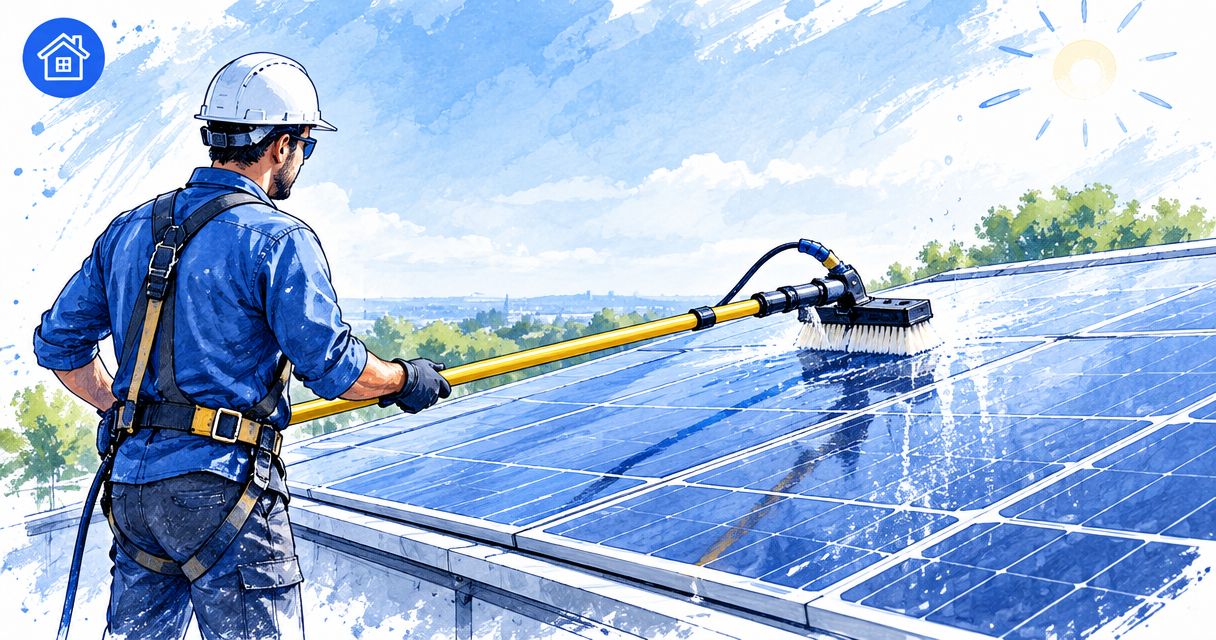
Yes, rooftop solar panel cleaning is safe for the panels when the method follows the panel manufacturer’s instructions, avoids abrasive contact, and keeps water away from damaged electrical components. The separate concern is roof access: a panel-safe cleaning method does not make climbing onto your roof safe.
- Is solar panel cleaning safe? Yes, when the method follows the panel manufacturer’s cleaning instructions.
- Avoid walking on panels, scraping deposits, or treating rooftop solar glass like a driveway.
- Lavarecleans offers solar panel cleaning for homeowners in Santa Barbara, Montecito, Ojai and Ventura.
- Before booking, confirm the cleaning method, roof access plan and response to visible damage.
Is rooftop solar panel cleaning safe for the panels?
Solar panel cleaning is safe when the equipment, water, contact method and access plan suit the installed system. The manufacturer’s instructions take priority over a cleaner’s usual routine. A method used on windows or paving is not automatically suitable for solar modules.
For your 2026 maintenance plans, start with the panel model and its cleaning instructions—not a promise that any dirty surface can be washed. The comparison below separates the benefit of each approach from its limits.
| Approach | Best for | Benefit | Limit or concern |
|---|---|---|---|
| Rain alone | Leaving safely inaccessible panels undisturbed | No brushing or roof access | Does not reliably remove every attached deposit |
| Manufacturer-approved water cleaning | Loose surface dirt on intact panels | Avoids unnecessary chemicals | Water quality, temperature and application still matter |
| Approved soft cleaning tools | Deposits that need gentle contact | Allows controlled cleaning | Trapped grit or unsuitable tools can scratch surfaces |
| Qualified assessment before cleaning | Visible damage or uncertain electrical condition | Establishes whether cleaning should proceed | Cleaning must wait until the concern is resolved |
Your decision is not simply whether to wash. It is whether the proposed method fits your panels and roof. The guide to solar panel cleaning methods ranked by safety in Ventura covers that method-first comparison.
Why this matters
Rooftop solar combines glass, electrical components and an exposed working area. Protecting the glass is only part of the job. The roof covering, mounting area and electrical condition also deserve attention before water is introduced.
Around coastal Santa Barbara and Ventura, salt film is a relevant cleaning concern. Hillside dust matters in Ojai and Montecito. Neither condition justifies harder scrubbing without checking what the panel manufacturer permits.
A clean-looking panel is not proof of a safe cleaning job. Ask how the work will be done, not just how the finished glass will look.
What makes solar panel cleaning safer?
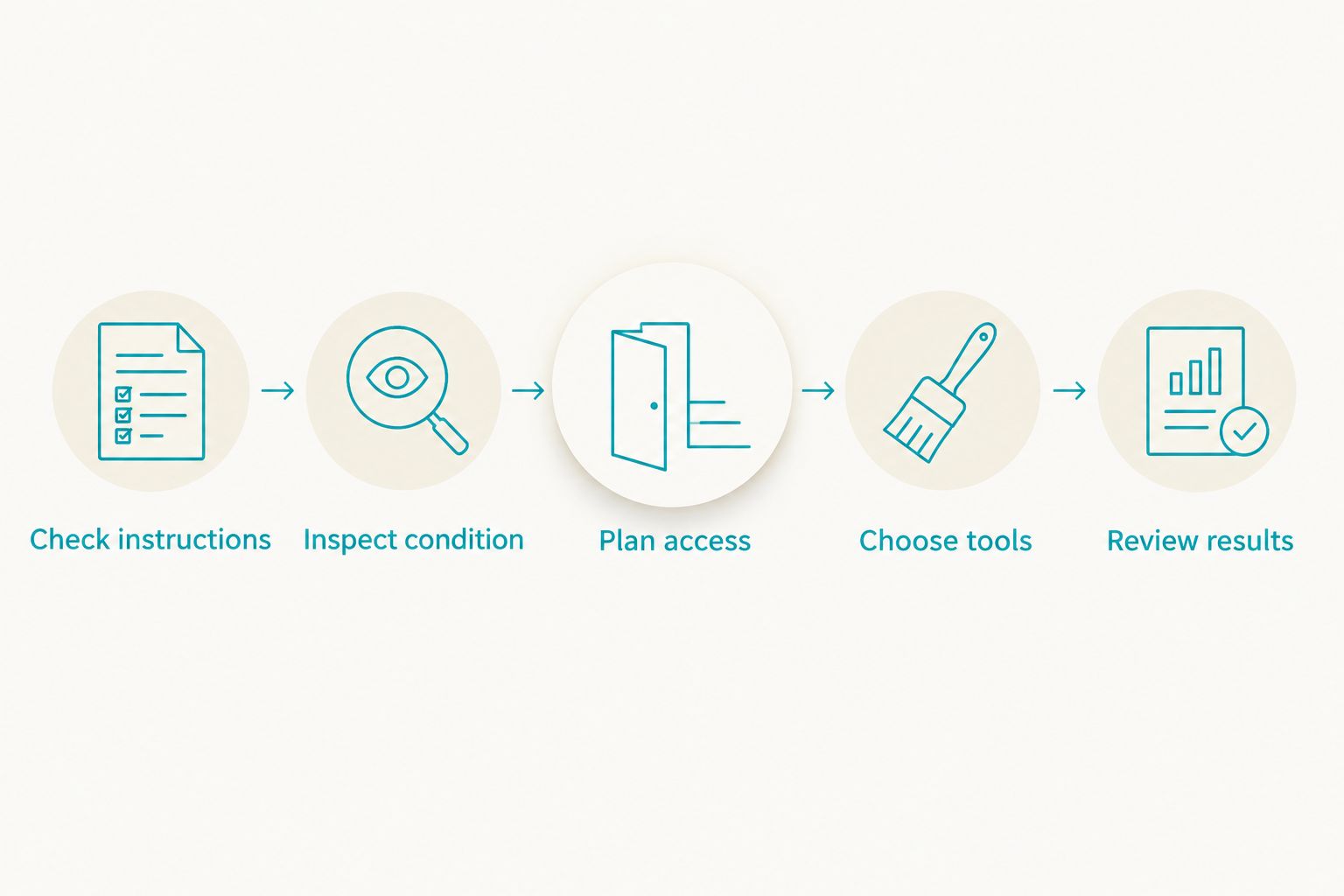
A sensible 2026 cleaning plan follows a clear order. Establish what is installed, check for reasons to stop, and choose the method only after those checks.
- Check instructions. Find the cleaning guidance for your panel model. Ask the installer for help identifying it if your handover documents are incomplete.
- Inspect condition. Look for visible cracks, displaced parts or other concerns from a safe location. Do not climb onto the roof to investigate.
- Plan access. Establish how the cleaner will reach the array without stepping on panels or putting unsuitable loads on the roof.
- Choose tools. Confirm that the water, brushes and any cleaning agents comply with the manufacturer’s instructions.
- Review results. Ask what happens if deposits remain or damage becomes visible during cleaning. More force is not the automatic next step.
The order matters. Choosing a brush before checking the panel instructions skips the information that determines whether the brush is suitable.
Water cleaning: suitable only within the panel instructions
Water is not a blanket permission to rinse every part of a solar installation. The cleaning instructions should govern where water is applied and what equipment is used. Damaged components need assessment, not a test spray.
Water quality also matters to the finish. Dissolved minerals can remain on glass after water evaporates. Ask whether the proposed water treatment suits the panel manufacturer’s requirements rather than assuming that any hose rinse will dry without deposits.
Avoid sudden temperature changes. Do not spray cold water onto hot panels as an improvised cleaning method; follow the manufacturer’s temperature guidance. A cooler working period also does not remove the need for safe roof access.
For a 2026 appointment, ask the cleaner to explain the water method in plain language. You should understand what reaches the glass, how it is applied, and what happens if the panel surface is too hot for the planned work.
Soft tools: useful only when contact is appropriate
A soft brush can still carry grit. Dragging trapped particles across glass creates an avoidable abrasion risk, so tool condition matters alongside the material printed on its label.
Ask how loose debris is handled before contact and how the cleaner keeps the tool clean. The answer should fit the panel manufacturer’s guidance. A tool being suitable for ordinary windows does not establish that it suits every solar panel coating.
Stubborn bird droppings or attached debris do not justify scraping with whatever is available. If an approved gentle method leaves a deposit behind, stop and establish the next permitted step. Protecting the panel takes priority over removing every mark during the visit.
The same restraint applies to cleaning agents. Do not assume household glass cleaner, detergent or a product described as environmentally friendly is approved for your array.
Why solar panel cleaning safety varies
The right method depends on the installation, not just the amount of dirt. These factors change the preparation and the decision to proceed:
- Panel instructions: Different models have their own cleaning requirements. Match the method to the installed module.
- Visible condition: Cracked glass, exposed wiring or displaced components call for qualified assessment before cleaning.
- Roof access: Pitch, roof covering, edges and obstacles affect how the work can be reached safely.
- Surface deposits: Loose dust and firmly attached debris need different handling. Harder contact is not the default answer.
- Water and temperature: Mineral residue and sudden temperature changes are reasons to plan the rinse carefully.
- Weather conditions: Wind, rain and slippery surfaces affect whether the work should proceed.
Use those factors to compare quotes in 2026. A clear explanation of the work is more useful than a general claim that solar cleaning is always harmless.
Is cleaning from the ground safer than climbing onto the roof?
Cleaning from the ground avoids placing a person on the roof, but reach alone does not establish that a method is suitable. The cleaner still needs control of the tool and a clear understanding of where water and equipment will go.
A long pole is not a reason to work near overhead electrical lines. Nor does it justify pressing hard against a panel that is difficult to reach. If the array cannot be reached safely with the proposed equipment, change the plan rather than stretching the method beyond its limits.
Roof access needs its own assessment. Ask how the crew protects the roof covering and avoids walking on the modules. Do not accept panel walking as a normal shortcut between sections of the array.
You do not need to climb up alongside the cleaner to check the work. Ask for a ground-level explanation of the access plan and how the finished condition will be reviewed.
Can a pressure washer damage solar panels or nearby windows?
A pressure washer is not a default solar panel cleaning tool. Do not authorize its use unless the panel manufacturer explicitly permits the proposed equipment and operating method. A driveway-cleaning setup does not become suitable because the operator stands farther back.
Combining exterior jobs makes this distinction important. The pressure washing risks for windows reinforce a broader rule: nearby glass needs its own protection plan, not the same treatment as hard paving.
For a combined 2026 visit, ask the contractor to separate the methods for the driveway, windows and solar array. Identify nearby glazing, seals and electrical equipment before washing starts. Covering several services in one appointment should not blur those boundaries.
That is especially useful when you are arranging window cleaning alongside solar care. You can coordinate the visit while still requiring a separate explanation for each surface.
What should you ask before booking solar panel cleaning?
Ask for a method you can understand without specialist vocabulary. You are not expected to design the job, but you should know what the cleaner intends to do and where the limits are.
Use these questions when requesting a quote:
- Which cleaning instructions will you follow for my panel model?
- Will anyone need roof access, and how will that be managed?
- What water, tools and cleaning agents do you propose?
- What happens if you find cracked glass or another electrical concern?
- Will you stop if a deposit does not respond to the approved method?
- How will nearby windows, roof surfaces and landscaping be protected?
- What is included in the cleaning, and what needs a separate specialist?
Lavarecleans is best suited to homeowners seeking local residential solar panel cleaning in Santa Barbara, Montecito, Ojai and Ventura. The local crew handles exterior cleaning and promises to return and make it right if you are unhappy; panel repairs or electrical concerns still need a separate qualified assessment.
You can request a free in-person quote from Lavarecleans. Use the visit to discuss the array, access and any window cleaning you want considered alongside it.
Does professional cleaning protect your solar panel warranty?
Professional cleaning does not automatically protect a warranty. The applicable warranty terms and manufacturer’s maintenance instructions determine what is required or excluded. Hiring someone does not cancel those conditions.
Keep the panel model, cleaning guidance and agreed scope with your home maintenance records. Ask for the proposed method in writing, particularly where a contractor plans to use cleaning agents or equipment that needs manufacturer approval.
For your 2026 records, separate cleaning from inspection and repair. A cleaning visit is not an electrical safety certification, and clean glass does not establish that every component is functioning correctly.
Should you clean panels whenever they look dusty?
Visible dust alone does not establish the urgency of cleaning. Consider the manufacturer’s guidance, the type of deposit and whether safe access is available. Do not turn a cosmetic concern into an unnecessary roof-access risk.
Coastal film, hillside dust and bird droppings are different conditions. Describe what you can see from the ground when requesting a quote. Do not climb up to take a closer photograph.
A monitoring app also does not diagnose dirt by itself. Changes in sunlight, shading or system condition can affect generation. If output concerns persist, ask the installer to assess the system rather than treating repeated cleaning as the only answer.
FAQ
Is solar panel cleaning safe for rooftop panels?
Solar panel cleaning is safe when it follows the panel manufacturer’s instructions and uses suitable tools, water and access methods. Visible damage or electrical concerns need assessment before cleaning proceeds.
Can I clean solar panels with a garden hose?
A garden hose is suitable only if its use matches your panel manufacturer’s cleaning instructions and the work can be done safely. Water quality, panel temperature and nearby electrical components still need consideration.
Can I use a pressure washer on my solar panels?
Do not use a pressure washer unless the panel manufacturer explicitly permits the proposed equipment and method. Permission to pressure wash a driveway does not apply to the solar array.
Is it safe to walk on solar panels while cleaning them?
Do not walk on solar panels to clean them. The access plan should avoid loading the modules and should address the roof covering and fall hazards separately.
Will rain clean my solar panels well enough?
Rain does not reliably remove every type of solar panel deposit. It avoids brushing and roof access, but attached debris can remain; follow the manufacturer’s maintenance guidance.
Does professional solar cleaning guarantee my warranty stays valid?
Professional solar cleaning does not guarantee warranty coverage. Check the applicable warranty terms and confirm that the proposed cleaning method follows the manufacturer’s instructions.
Does Lavarecleans offer local solar panel cleaning?
Lavarecleans offers residential solar panel cleaning in Santa Barbara, Montecito, Ojai and Ventura. Request a free in-person quote to discuss your array, access and cleaning scope.
One last thing
A cleaner who stops at an unexpected defect is protecting your home, not leaving the job unfinished. Agree on that stopping point before work begins. If cleaning reveals cracked glass or another concern, the next step is assessment—not more water, harder brushing or a stronger chemical.