

Montecito estate holiday light installation is the planning and mounting of seasonal outdoor lighting with the aim of creating a coordinated display across a larger residential property. This guide covers design, access, electrical checks and removal; estates need those decisions settled before lights go onto gates, rooflines or trees.
- Lavarecleans offers holiday light installation for Montecito estates; start with a free in-person quote and a defined scope.
- Choose lighting from your arrival view, then check how it looks from inside the house.
- Agree on mounting methods, power routes, maintenance and removal before approving installation.
- Coordinate window cleaning and gutter cleaning before lighting makes those areas harder to reach.
Why holiday lighting matters for Montecito estates
An estate display needs to work as a whole, not as separate decorations purchased for each building. A long approach, mature landscaping and a house set back from the road create different viewing conditions. Lighting every available surface is not the same as making the property look considered.
Your 2026 plan should identify what visitors actually see: the entrance, the approach and the front elevation. Then check the view from occupied rooms. Lights that frame the house from outside can become distracting when they sit directly beyond a bedroom window.
Lavarecleans holiday light installation is best for Montecito homeowners who want a local crew and an in-person discussion of the work. Request a free in-person quote through Lavarecleans and use the visit to settle scope, access and expectations. The company promises to return and make it right if you are unhappy; confirm the specific maintenance and removal arrangements separately.
How to plan your estate holiday lighting
1. Define the arrival view
Start with a daylight walk from the entrance to the front door. Take photographs from the places where guests pause, turn or park. These become your design references, rather than a collection of unrelated inspiration pictures.
Choose one feature to lead the display. That might be the main roofline, an entrance arch or a prominent tree. Supporting lighting should make that feature easier to read, not compete with it.
For your 2026 brief, use 3 viewing positions: the entrance, the approach and the front door. This is a planning exercise, not a requirement to decorate every position. Mark any area that should stay dark, including neighboring windows and rooms where you want an undisturbed evening view.
Walk the same route after sunset before approving the design. Existing landscape lighting changes the balance. A feature that looks central in daylight can disappear behind a bright entry lantern at night.
- Choose a focal point: identify the feature guests should notice first.
- Mark quiet areas: record bedrooms, neighboring windows and dark garden edges.
- Photograph sightlines: capture the entrance, approach and front-door views.
- Keep routes clear: separate decorative features from walking and driving space.
2. Map access before choosing the full display
A ground-level plan starts with photographs and a simple sketch. Mark gates, steps, planting beds, parked vehicles and changes in grade. Do not climb onto a roof to collect dimensions for a quote.
Access determines whether a design is practical. A roofline above a sloped planting bed presents a different job from a reachable porch edge. Mature trees also need an access discussion before you decide how far lighting should extend into the canopy.
At the in-person visit, Lavarecleans can discuss your holiday lighting request alongside the property's access conditions. Ask which proposed areas belong in the installation scope and which need a different approach. Do not treat a design sketch as confirmation that every surface is suitable.
Keep 2 documents together: the marked property sketch and the written scope. If the design changes, update both. This avoids a familiar problem: the homeowner approves a picture while the installer prices a different description.
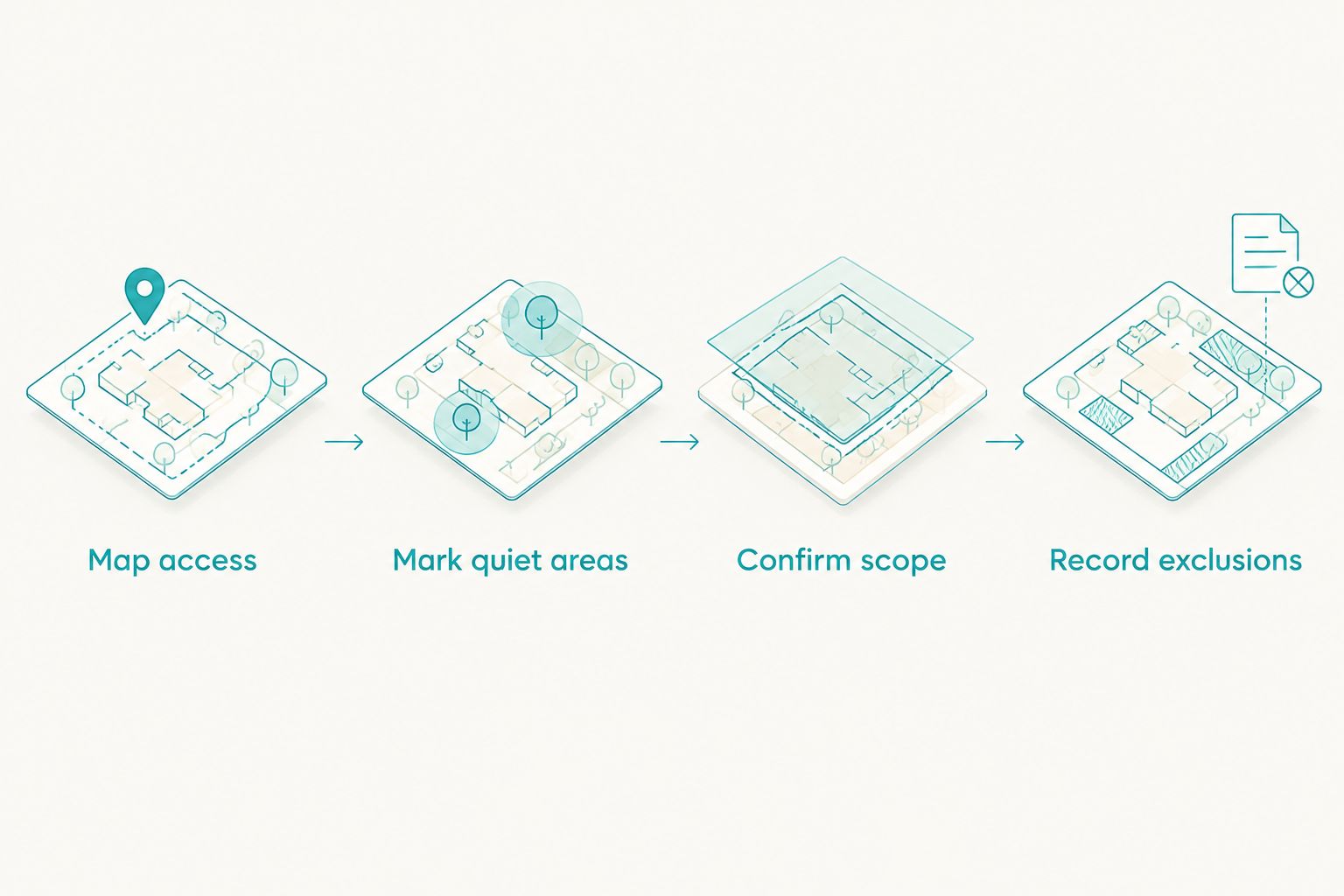
- Map access: identify gates, slopes, steps and equipment routes.
- Mark quiet areas: include planting and surfaces that need protection.
- Confirm scope: name each building, tree or entrance included.
- Record exclusions: list features left undecorated or needing separate assessment.
3. Approve mounting methods for each surface
Do not approve a single attachment method for the entire property. Tile edges, painted trim, gutters, masonry and tree branches need separate consideration. The question is not simply whether a light can be attached, but how it will be attached and removed.
From the ground, identify delicate finishes, existing damage and surfaces you do not want drilled. Photograph these areas and include the restrictions in the scope. Avoid experimenting with adhesives on a conspicuous finish.
Ask the installer to explain the proposed attachment for each feature and whether it requires penetrating the surface. Removable does not automatically mean damage-free. Follow the attachment manufacturer's instructions and the requirements of the surface involved.
The guide to installing holiday lights without drilling into trim addresses the right question to bring to the site visit. Confirm the method for your actual trim rather than assuming a general approach fits every detail.
- Identify surfaces: distinguish tile, trim, gutters, masonry and bark.
- Document condition: photograph fragile finishes and existing marks.
- Set restrictions: state where drilling or adhesive use is unacceptable.
- Confirm removal: ask how attachments come off without forcing them.
4. Check power routes and outdoor suitability
Begin with an inventory of existing outdoor receptacles and the locations of permanent landscape lighting. Note where cords would cross paths, pass through gates or sit near irrigation. Keep the assessment at ground level; unfamiliar wiring belongs with a qualified electrician.
Use lighting and extension equipment marked for outdoor use, following their instructions. Outdoor receptacles should have appropriate ground-fault circuit-interrupter protection. Do not bypass a protective device because it interrupts the display.
Connection limits depend on the actual lighting equipment. Read the manufacturer's maximum connected-set or load instructions instead of applying a generic rule from a different product. Long property boundaries do not justify joining strings indefinitely.
Ask who will check the completed setup and explain normal operation. A homeowner should know how to switch the display off without opening an electrical enclosure or reaching behind landscaping. Keep that explanation with the final scope.
- Locate receptacles: identify the intended supply points before choosing routes.
- Read equipment labels: check outdoor suitability and connection instructions.
- Protect circulation: keep cords out of walking routes and gate movement.
- Escalate electrical issues: refer damaged outlets or uncertain circuits to an electrician.
5. Sequence cleaning before installation
Plan exterior cleaning around the surfaces the lighting will occupy. Windows remain a year-round concern; holiday decorations should not make routine glass care unnecessarily awkward. Gutter cleaning is a separate seasonal decision, especially where leaves collect near proposed attachment points.
Coastal salt film on glass and hillside dust on exposed surfaces are reasons to assess cleaning, not reasons to wash everything. Walk the property and identify what actually needs attention. Avoid adding pressure washing simply because an installation visit is planned.
Lavarecleans provides window, solar panel, gutter and pressure-washing services as well as holiday lighting. Ask about the order of work when requesting your 2026 quote. Do not assume those services are included in the lighting scope or that every task should happen on the same visit.
Keep solar equipment clear of decorative attachments and cord routes. For any washing near installed lights or electrical connections, settle the method and sequence before work begins rather than improvising around the finished display.
- Inspect windows: identify glass that needs cleaning before decorations obstruct access.
- Assess gutters: check whether debris removal belongs ahead of installation.
- Separate washing: specify any driveway or exterior cleaning as distinct work.
- Protect solar equipment: keep lighting plans separate from panels and their wiring.
6. Write down operation and maintenance responsibilities
A lighting plan is unfinished until you know what happens after installation. Decide who operates the display, who reports a fault and who is authorized to change the setup. On a property with household staff or a manager, give everyone the same written instructions.
Set operating hours around the household, not just the street view. Consider bedrooms, evening arrivals and neighboring properties. If a timer is part of the agreed setup, ask for an explanation of how to adjust it and what happens after a power interruption.
For the 2026 season, separate a design change from a service problem. A failed section and a request to add another tree are different requests. Ask how each is handled without assuming either is included.
Complete 1 after-dark walkthrough once the display is operating. Check the arrival view, indoor glare and access routes together. Record any agreed correction clearly rather than relying on an informal conversation at the gate.
- Name a contact: choose who approves changes and reports problems.
- Record operating hours: agree when the display should turn on and off.
- Define maintenance: ask what follow-up work the agreement includes.
- Check after dark: review appearance and clear routes with the lights operating.
7. Agree on removal and storage before installation
Removal is part of the decision even when it is a separate service. Ask who takes the lights down, what the removal scope covers and how the timing will be arranged. Do not infer those terms from the word installation.
Ownership also needs a written answer. Customer-owned lights and installer-supplied arrangements create different questions about storage, replacement and future use. Confirm the actual arrangement rather than choosing on appearance alone.
Request a labeling plan if lights will be stored for reuse. Labels tied to locations make more sense than a pile of unnamed strings. Keep the approved design with the storage notes so the next installation does not depend on someone's memory.
Before signing your 2026 agreement, read the installation and removal descriptions side by side. Look for missing areas, unclear responsibilities and attachment removal. The written scope should explain how the property returns to its undecorated condition.
- Confirm removal: identify who handles takedown and how it is arranged.
- Establish ownership: record who owns the lights and attachments.
- Assign storage: specify who packs, labels and keeps reusable materials.
- Check surfaces: agree how attachment points are reviewed after removal.
Compare lighting approaches for your property
Choose an approach by the work you want to manage yourself. A smaller, clearly defined display is a better decision than an elaborate design with unresolved access or electrical questions. Each option below has a place, but none removes the need for a property-specific assessment.
| Option | Best for | Main advantage | Key limitation |
|---|---|---|---|
| Ground-level DIY display | Homeowners decorating reachable entry features | Direct control over placement and reuse | The homeowner handles setup, checks and removal; elevated work requires a separate plan |
| Professional installation of customer-owned lights | Homeowners who already have suitable outdoor equipment | Keeps existing materials in use | The installer must confirm condition, compatibility and willingness to use them |
| Installer-supplied lighting arrangement | Homeowners starting without an established display | Design and equipment can be discussed together | Ownership, substitutions, maintenance and storage need written terms |
| Lavarecleans holiday light installation | Montecito homeowners seeking a local crew and an in-person quote | Property-specific discussion with a provider of exterior cleaning services | Equipment, access, maintenance and removal must be confirmed in the individual scope |
When comparing estate Christmas light installation costs, compare the included work rather than the size of the house alone. Roof access, decorated features, equipment ownership and removal all belong in the comparison. An estate discussion from another market does not establish a Montecito quote; your property's scope does.
Common mistakes Montecito estate homeowners make
Decorating every building equally
A main house, guesthouse and gate do not all need equal emphasis. That approach can blur the arrival view. Choose the leading feature first, then decide which secondary areas support it and which should remain quiet.
Approving a photograph without an access plan
An inspiration image does not show your slope, planting beds or roof details. Pair the visual brief with the access sketch. Ask for alternatives when reaching a feature would disturb landscaping or require work outside the proposed scope.
Cleaning after the lights block the work
Window cleaning and gutter access are easier to plan before decorations occupy those areas. Identify the cleaning that is actually needed, then agree on sequence. Do not ask a cleaning crew to work around live decorative connections without discussing the setup.
Treating a satisfaction promise as a service schedule
Lavarecleans promises to return and make it right if a customer is unhappy. That promise does not replace written terms for routine maintenance, design additions, removal or storage. Ask about each item directly so expectations match the agreement.
Plan your Montecito holiday lighting
Request a free in-person quote to discuss your property, display and scope.
FAQ
What's the best way to plan holiday lighting for a Montecito estate?
Start with the arrival view, then document access, mounting surfaces and power routes. Approve a written scope that also addresses maintenance, removal and storage.
Can holiday lights be installed without drilling into my trim?
Some installations use non-penetrating attachments, but the method must suit the actual surface and equipment. Ask the installer to explain attachment and removal before approving the work.
Does holiday light installation include taking the lights down?
Removal is included only when the agreement says so. Confirm who handles takedown, which areas it covers and how the timing is arranged.
Should I clean my windows and gutters before installing holiday lights?
Complete needed cleaning before lighting obstructs the relevant surfaces or access routes. Specify window cleaning and gutter cleaning separately rather than assuming they are included with installation.
Can I use Christmas lights I already own?
Ask the installer to assess your existing lights before including them in the design. Outdoor suitability, condition, connection instructions and the installer's acceptance all matter.
What changes the scope of estate holiday lighting?
Decorated features, access conditions, mounting methods, equipment ownership and follow-up responsibilities change the scope. Compare written descriptions of the same work before choosing an installer.
Can I request an in-person holiday lighting quote in Montecito?
Lavarecleans invites homeowners to request a free in-person quote. Use the visit to discuss the display, access restrictions and the specific services you want included.
One last thing
Review the design from inside the house before you approve it. Stand where you sit in the evening, then look toward the proposed lights. The display should welcome guests without taking over your own view. Put any bedroom or living-room restrictions into the brief while changes are still on paper.