

Do not pressure wash a Ventura wood deck by default: start with the wood’s condition, the existing finish, and the manufacturer’s cleaning instructions. Pressure washing can remove surface dirt, but an unsuitable spray can gouge boards, raise wood fibers, and damage a finish; deteriorated wood needs repair rather than stronger cleaning.
- For pressure washing ventura projects, inspect wood decks before choosing equipment; gentler cleaning is the starting point.
- Pressure washing can damage wood fibers and coatings; a successful test patch matters more than a machine’s maximum pressure.
- Lavarecleans offers local exterior cleaning; request an in-person quote before deciding how your deck should be cleaned.
- Clean boards are not necessarily ready for stain. Follow the coating manufacturer’s drying and preparation instructions.
Should you pressure wash a Ventura wood deck?
Only consider pressure washing when the wood is sound, the finish allows it, and a discreet test shows no damage. Do not use a pressure washer to investigate soft boards, remove every stubborn mark, or force a peeling coating off without a separate refinishing plan.
Lavarecleans is best for homeowners who want a local exterior-cleaning quote before choosing a washing method. Its pressure-washing service is relevant to the conversation, but your deck’s material and condition must determine the proposed approach.
| Approach | Best for | Main benefit | Main limitation |
|---|---|---|---|
| Gentle washing | Routine dirt on sound wood with compatible cleaning instructions | Avoids relying on a forceful spray | Does not repair wood or restore a failing coating |
| Pressure-assisted cleaning | Sound wood where the manufacturer permits the method | Helps rinse loosened surface dirt | Incorrect technique can mark boards and damage finishes |
| Separate stripping and refinishing | A coating that needs removal or renewal | Addresses the finish rather than disguising failure | Requires a different scope from routine cleaning |
| Repair before cleaning | Soft, loose, split, or otherwise unsafe boards | Addresses the underlying defect | Cleaning must wait until the damaged area is assessed |
These are different jobs, not interchangeable packages. Ask the person quoting the work to explain which one your deck needs and why.
Why this matters
A deck can look dirty and still have a sound finish. It can also look merely weathered while hiding loose fasteners, soft spots, or a coating that no longer adheres properly. Cleaning should not blur those distinctions.
If deck cleaning is on your 2026 home-maintenance list, decide whether your goal is removing dirt or preparing for refinishing. That decision changes the method, the preparation, and what a reasonable finished result looks like.
Coastal salt film and hillside dust are familiar concerns around Ventura homes. Neither is a reason to start with a more aggressive spray. Match the cleaning method to the surface, not just the visible dirt.
Gentle washing: the starting point for routine dirt
Gentle washing means using a cleaner approved for the wood and finish, suitable agitation, and the rinse method specified by the manufacturer. It does not mean applying any household cleaner and hoping a light rinse makes it safe.
Start by identifying the surface. Bare wood, stained wood, painted boards, and composite decking do not automatically share cleaning instructions. If you cannot identify the coating, avoid experimenting across the whole deck.
A soft brush and compatible cleaner give you a controlled starting point for ordinary surface dirt. The limitation is straightforward: washing cannot replace missing finish, correct splintering, or make decayed wood sound again.
Choose gentle washing for maintenance, not as a substitute for repair or restoration. If the surface still looks uneven after cleaning, identify the cause before repeating the treatment.
Pressure-assisted cleaning: only after inspection and testing
A pressure washer is equipment, not a complete cleaning plan. The nozzle, spray pattern, working distance, direction, and time spent on one spot all affect what reaches the wood.
Ask for a test in a discreet area before broad cleaning begins. The test should use the proposed cleaner and method, not a gentler demonstration that changes once the main work starts. Inspect the test area after it dries, because wet wood can hide differences in color and texture.
Look for fuzzy fibers, grooves, chipped coating, and a sharply defined clean stripe. Those are reasons to stop and reconsider the method, not evidence that another pass is needed.
Pressure-assisted cleaning has a place when the surface and its instructions support it. Its limitation is the potential to turn a maintenance job into sanding or refinishing work. Do not accept maximum machine pressure as proof of cleaning quality.
Repair or refinish first: when washing is the wrong next step
Stop before washing if boards feel soft, move underfoot, have pronounced splitting, or show exposed fasteners that create a hazard. Keep people away from an unsafe area and arrange an appropriate assessment.
Peeling paint or stain presents a different problem. A cleaning quote should not quietly become a coating-removal job halfway through the visit. Ask whether the proposed work is intended to preserve the finish or prepare it for replacement.
Dark marks also need identification. Dirt, biological growth, metal-related discoloration, and changes in the wood itself do not all respond to the same treatment. A contractor should explain what the cleaning is intended to remove and what is expected to remain.
Choose repair for damaged wood and a separate refinishing scope for a failing coating. More force is not a diagnosis.
Why the right deck-cleaning method varies
Your neighbor’s deck is not a reliable specification for yours. These factors determine whether a proposed method fits:
- Wood condition. Sound boards and deteriorated boards cannot be treated as equivalent surfaces.
- Existing finish. Cleaning must account for whether the wood is bare, stained, painted, or covered by another coating.
- Manufacturer instructions. Decking and coating guidance takes priority over a generic washing routine.
- Type of buildup. Loose dust, surface growth, and embedded discoloration call for different decisions.
- Surrounding materials. Nearby glass, painted trim, metal fixtures, and planting affect protection and rinse planning.
- Your next step. Routine maintenance and preparation for a new coating require different scopes.
For a 2026 project, keep a copy of the current product instructions with your quote. That gives you a clear basis for discussing the method instead of relying on a verbal promise that the operator will be careful.
How should you prepare a wood deck for cleaning?
A good preparation sequence exposes problems before equipment reaches the boards. It also keeps your belongings and surrounding surfaces out of the work area.
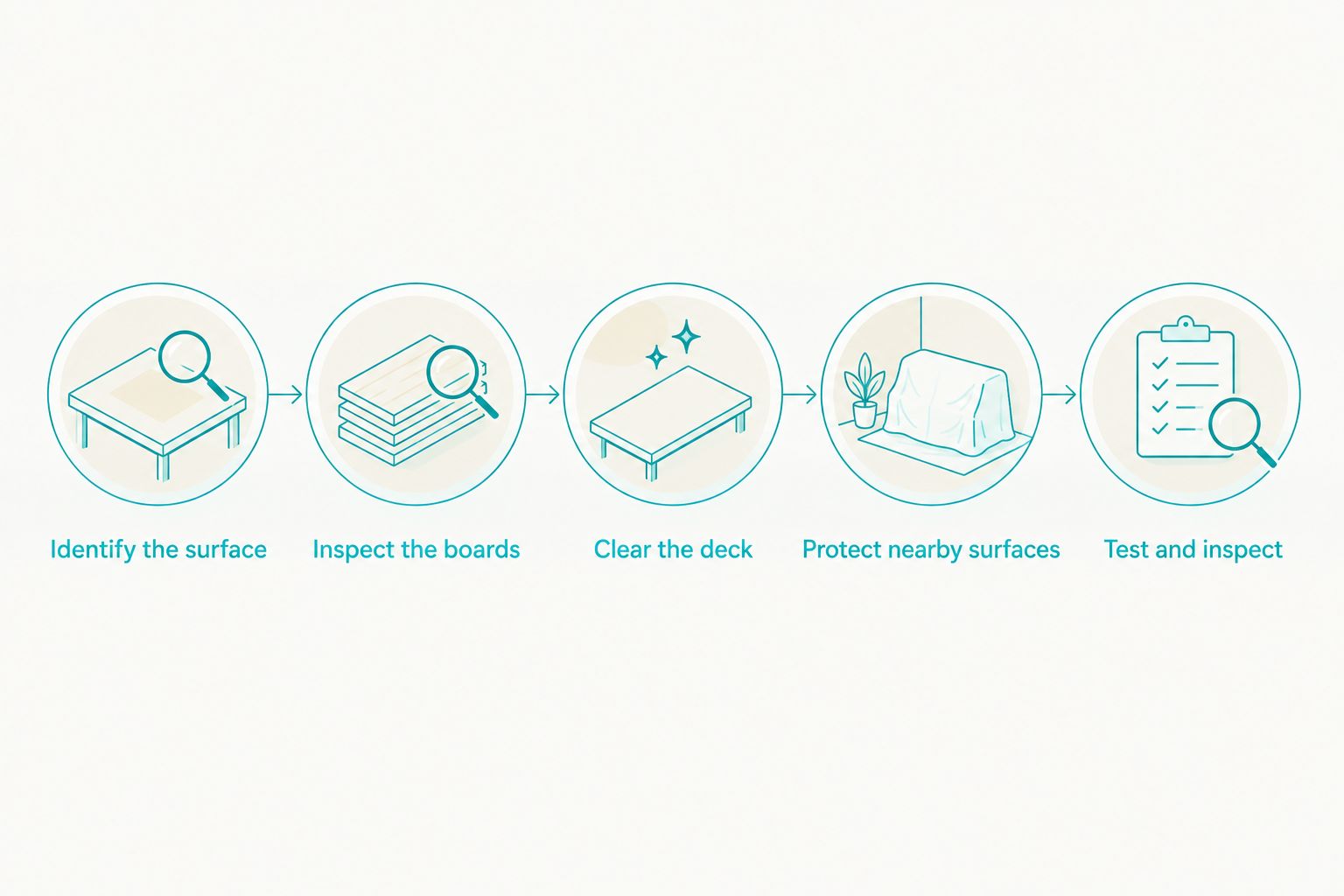
- Identify the surface. Find the decking and coating information you have. Tell the cleaner about previous treatments, repairs, and any areas where the finish has changed.
- Inspect the boards. Flag soft spots, loose boards, protruding fasteners, and damaged edges. Do not ask cleaning equipment to work around an unresolved safety problem.
- Clear the deck. Move furniture, rugs, planters, and loose items. Check underneath them for trapped debris and surface differences.
- Protect nearby surfaces. Discuss planting, doors, electrical fixtures, and where rinse water will travel. Follow the cleaner’s label and applicable local requirements.
- Test and inspect. Agree on a discreet test area and examine the dry result before approving the full method.
Preparation outside the deck matters too. The guide to preparing a Ventura home for pressure washing addresses the broader property-preparation conversation; your wood deck still needs its own surface-specific plan.
How should you protect nearby windows, plants, and walkways?
Treat the deck as part of the house, not an isolated cleaning surface. Spray and rinse water can reach nearby windows, painted doors, siding, steps, and planting beds. Discuss those boundaries before work starts.
Move portable planters rather than cleaning around them. Identify outdoor outlets and fixtures, keep doors closed, and make sure the proposed cleaner is suitable for the surrounding materials. Do not direct water into gaps around doors or building openings.
A safe washing plan includes where the water goes. Keep loosened debris and cleaning solution from being directed into a storm drain, and follow the product label and applicable local runoff rules. Ask the contractor how runoff will be controlled rather than assuming a driveway drain is an acceptable destination.
The same planning applies if you are doing the work yourself. DIY pressure washing safety includes controlling the spray, footing, and nearby electrical hazards—not just keeping the nozzle pointed away from the wood. Never put a hand in the spray or use a ladder as a washing platform.
Arrange window cleaning around the exterior work when both are planned. Cleaning nearby glass after splash-producing work avoids undoing a finished window clean. Lavarecleans provides window cleaning as well as pressure washing, so ask how the work should be sequenced rather than assuming both tasks share one method.
What should a 2026 deck-cleaning quote include?
A useful quote explains the proposed work in plain language. It should distinguish cleaning from repairs, stripping, sanding, and applying a new finish. Do not compare quotes as though those scopes are equivalent.
Ask for these details before you approve the work:
- The surface and condition the quote covers.
- The cleaner and washing method proposed for that surface.
- How the test area will be assessed.
- Which surrounding surfaces need protection.
- What discoloration or finish damage is outside the cleaning scope.
- Whether drying, sanding, or recoating is part of a separate job.
Lavarecleans offers a free in-person quote and promises to return and make it right if you are unhappy. That gives you a chance to discuss the actual deck with a local crew; it does not remove the need to agree on the method and expected result beforehand.
Request an in-person quote if you cannot identify the finish or see signs of damage. Describe the concern without prescribing the equipment. Asking how the surface should be cleaned is more useful than asking for the strongest wash.
Can you stain a wood deck immediately after washing?
No—do not stain a deck just because the surface looks dry. Follow the coating manufacturer’s requirements for dryness, preparation, weather, and application conditions.
Washing and stain readiness are separate checkpoints. Ask who will assess the deck before coating, especially when different contractors handle cleaning and refinishing.
Will pressure washing remove every dark mark?
No—pressure washing is not a reliable treatment for every kind of discoloration. Identify the mark before increasing force or changing chemicals.
If a mark remains after an appropriate cleaning test, ask whether it involves the finish, metal contact, or the wood itself. A remaining stain is not permission to keep spraying the same board.
FAQ
Is pressure washing safe for an old wood deck?
Age alone does not determine whether pressure washing is suitable; the wood’s condition, finish, and manufacturer’s instructions do. Soft, loose, or badly split boards need assessment before cleaning.
What should I ask a pressure washing Ventura company before booking?
Ask how the company will identify your deck’s surface, test the proposed method, and protect nearby materials. Confirm whether the quote covers cleaning only or includes separate restoration work.
Can I use the same pressure-washer setting on concrete and wood?
Do not assume a concrete-cleaning setup is suitable for wood. Follow the decking and coating instructions and assess a discreet test before treating the full surface.
Does a fuzzy deck surface mean the cleaning worked?
No—raised or fuzzy fibers can indicate surface damage. Stop using that method and assess whether additional preparation is needed before any coating work.
How should I plan deck cleaning in 2026?
For deck cleaning in 2026, identify the wood and finish, inspect for damage, and agree on a test area before approving the method. Keep maintenance cleaning separate from repairs and refinishing.
Can I book window cleaning with exterior washing?
Ask to coordinate the sequence when booking both services. Complete nearby splash-producing work before the final window clean so runoff does not undo freshly cleaned glass.
One last thing
Judge the test patch after it dries, not while it is wet. Water can make color differences less obvious, so a freshly rinsed board is not the final result.
Before your 2026 deck-cleaning appointment, photograph the dry surface and point out existing marks. Those photos give you and the cleaner a shared starting point—without confusing old damage with the outcome of the wash.