

Clean gutters before the rainy season, then clean again whenever leaves, needles or other debris obstruct drainage. The right annual frequency depends on what collects on your roof and whether water moves freely through the gutters and downspouts—not a fixed calendar alone. For your 2026 home-care plan, pair seasonal cleaning with ground-level checks after wind, leaf drop and rain.
- How often should gutters be cleaned? Before seasonal rain, then whenever debris obstructs drainage.
- Oak leaves, pine needles and recurring overflow call for closer attention than a calendar reminder alone.
- Gutter guards still need inspection; surface buildup and blocked outlets can interrupt drainage.
- Lavarecleans gutter cleaning suits local homeowners who want a crew to assess the work in person.
Why this matters
A gutter can look clear from the yard while its outlet holds a plug of wet leaves. Water spilling over the edge is a reason to investigate, not proof that you simply need more frequent cleaning.
Your 2026 schedule should answer separate questions: when does debris collect, and does the system drain properly afterward? Cleaning addresses debris. A loose joint, damaged section or poor drainage arrangement needs a different response.
For homeowners in Santa Barbara, Montecito, Ojai and Ventura, Lavarecleans offers gutter cleaning alongside window and other exterior cleaning services. Keep the gutter scope explicit when requesting a quote; work on the glass does not describe work inside the roof drainage system.
How many times a year should gutters be cleaned?
Schedule a pre-rain cleaning, then let actual buildup determine additional visits. A home beneath overhanging trees needs a different plan from a home with little debris reaching the roof.
Use this comparison to choose a maintenance approach. These are planning recommendations, not reports from individual homes.
| Maintenance approach | Best for | Main benefit | Limit |
|---|---|---|---|
| Pre-rain cleaning with follow-up checks | Homes without recurring buildup | Prepares drainage before seasonal rain | Later wind or leaf drop can create new blockages |
| Cleaning around recurring debris drop | Homes beneath shedding trees | Responds to the source of gutter debris | Requires attention beyond a standing appointment |
| Inspection when overflow appears | Any home with a drainage problem | Helps separate a blockage from a repair issue | Waiting for overflow is not a substitute for preventive care |
| Guard inspection and debris removal | Homes with gutter guards | Addresses material resting on or entering the guard | Guards do not remove the need for maintenance |
Do not treat these approaches as competing packages. Your home can need pre-rain cleaning, a later debris check and an investigation of a troublesome downspout.
Before seasonal rain: establish a clear starting point
Plan gutter cleaning while access is safe, before you need the system to carry sustained runoff. Remove accumulated debris rather than waiting for rain to reveal where it has collected.
For a 2026 pre-rain appointment, ask what the work includes: gutter channels, accessible outlets, downspout checks and cleanup of removed material. A description of the work is more useful than the word thorough without an explanation.
Afterward, observe the system from the ground during rain when conditions allow. Look for water spilling over an edge, leaking at a joint or collecting near a discharge point. Stay away from slippery steps and do not climb a ladder in wet or windy conditions.
A clear starting point also makes later problems easier to describe. You can tell the cleaner that a particular corner overflowed after the appointment, rather than trying to judge the whole roofline from memory.
After leaf drop or wind: check what changed
A seasonal appointment cannot prevent new debris from landing in a clean gutter. Check accessible sightlines after noticeable leaf drop or wind, especially where branches extend above the roof.
An oak-shaded Montecito property and a more exposed Ventura property should not share a schedule simply because both have gutters. Look at the actual debris source. Leaves, small twigs and needles collect differently, and roof valleys can direct them toward particular outlets.
From the ground, watch for visible piles at gutter edges, material gathered around guards and a downspout that behaves differently during rain. Do not climb onto the roof to confirm a suspicion. Describe the location and arrange a closer assessment if you cannot see it safely.
A new buildup deserves attention even when the next calendar reminder is far away. Conversely, an inspection does not automatically mean another cleaning is necessary.
Why gutter-cleaning frequency varies
Your maintenance plan should follow observable conditions rather than assumptions about your neighborhood.
- Overhanging trees. Branches above the roof create a direct route for leaves, needles and small twigs to reach gutters. Check where the material lands, not just whether your yard has trees.
- Debris timing. Shedding and wind can add material after a scheduled visit. Move your checks around those events instead of relying entirely on a recurring date.
- Roof layout. Valleys and intersecting roof sections concentrate runoff and debris at particular points. Ask which outlets deserve closer attention.
- Gutter guards. Covers change where debris gathers; they do not make leaves or needles disappear. Inspection must account for the guard surface and the drainage beneath it.
- Recurring drainage symptoms. Repeated overflow at the same location warrants investigation. More appointments will not correct a defect that requires repair.
Height and access also affect how work should be performed. They are reasons to discuss a safe method, not reasons to ignore a gutter until it spills over.
Build a gutter-care schedule around your home
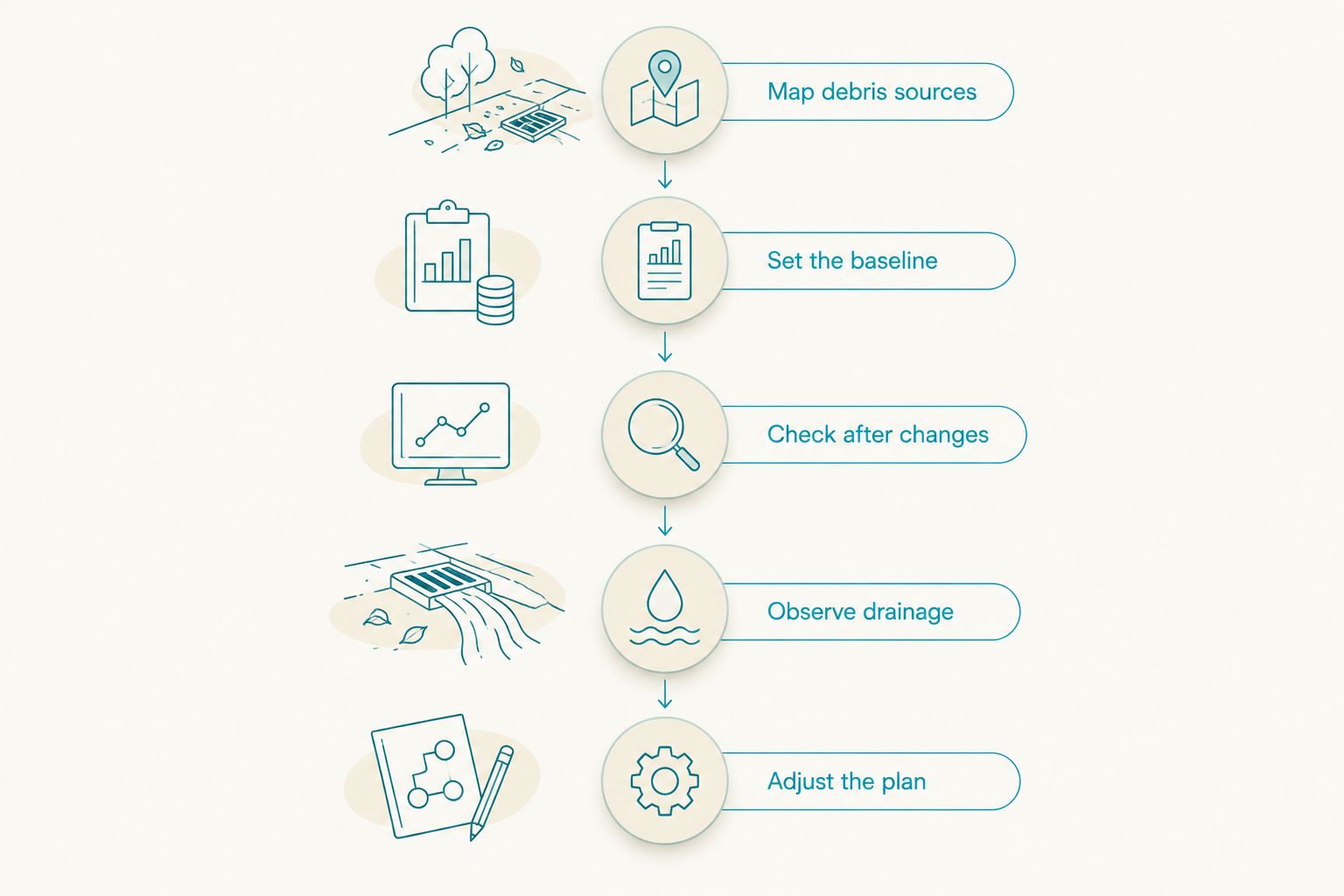
Use the following sequence to turn a general reminder into a practical 2026 maintenance plan. You do not need roof access to begin.
- Map debris sources. From safe ground, note trees above the roof and places where you regularly see leaves or needles collect. Identify sides of the house by a clear landmark, such as the driveway or patio.
- Set the baseline. Arrange cleaning before seasonal rain and confirm the included work. Tell the cleaner about past overflow, inaccessible areas and any gutter guards.
- Check after changes. Look again after noticeable shedding, wind or nearby tree work. Request an inspection when you see buildup or cannot judge a troublesome area safely.
- Observe drainage. During rain, watch from a protected ground-level position. Note where water escapes and whether the problem appears at an edge, joint or downspout.
- Adjust the plan. Use repeated observations to decide where another visit belongs. If a clear gutter still overflows, ask for the cause to be assessed rather than simply repeating the same cleaning.
This sequence gives each visit a purpose. It also helps you explain the problem without guessing whether every gutter on the house needs the same attention.
Do gutter guards mean you can clean less often?
Gutter guards can reduce the amount of some debris entering the channel, but the maintenance task changes rather than disappears. Material resting on top still needs attention when it interferes with water entering the gutter.
The important question is not whether a guard is installed. It is whether the guard, gutter outlet and downspout work together under the conditions at your home. A clean-looking cover does not establish that the outlet below it is clear.
Needle-heavy debris deserves a specific conversation because needles behave differently from broad leaves. When assessing gutter guards for pine needles, consider the openings and the maintenance access rather than treating every cover as interchangeable. Advice written for Georgia does not establish a cleaning schedule for a California property; your roof, trees and observed drainage still set that schedule.
Before booking work on guarded gutters, explain which sections have covers. Ask whether inspection or cleaning requires removing anything, who handles reinstallation and whether access restrictions change the scope. Do not assume that routine gutter cleaning includes dismantling an unfamiliar guard system.
Should I wait until my gutters overflow?
Do not use overflow as your routine cleaning reminder. It tells you that water is already leaving the intended drainage path, and it does not tell you why.
Leaves can obstruct an outlet, but debris is not the only possible cause. A damaged gutter, displaced section or drainage arrangement can also need attention. Describe the symptom accurately instead of diagnosing it from the yard.
Useful observations include where the water spills, whether the same location repeats and whether the issue remains after cleaning. A ground-level photo taken without stepping into unsafe conditions can help explain the location. Do not lean out of an upstairs window to capture it.
Is cleaning before the rainy season enough?
Pre-rain cleaning is a starting point, not a promise that gutters will stay clear. If fresh debris arrives afterward, the system needs another check.
Match the next decision to what you find. Visible buildup calls for attention; persistent overflow after debris removal calls for investigation. A quiet stretch without obvious problems does not replace checking places you cannot see from the ground.
If you have just moved in, ask about known drainage trouble and previous maintenance. Treat that history as background, then establish the current condition rather than assuming the previous schedule fits your use of the home.
What to confirm in a gutter-cleaning quote
A useful quote describes the work and its limits. For your 2026 appointment, point out guarded sections, awkward access, delicate planting and any area where water has previously escaped.
Ask these questions before agreeing to the work:
- Does the scope cover gutter channels and accessible outlets?
- How will downspout flow or suspected blockages be assessed?
- What changes if guards restrict access?
- How will removed debris be collected and cleared away?
- Will damaged sections or unresolved drainage problems be identified separately?
Lavarecleans gutter cleaning is best for local homeowners who want an in-person assessment before agreeing to the scope. The local crew serves Santa Barbara, Montecito, Ojai and Ventura, takes care with the work and promises to return and make it right if you are unhappy. Cleaning is not a substitute for repairing damaged gutters.
Request a free in-person quote and show the crew the areas that concern you. If window cleaning is also on your list, discuss it separately so each service has a clear scope. Solar panel cleaning, pressure washing and holiday lighting should likewise follow their own access and scheduling needs.
Plan your gutter cleaning
Request a free in-person quote for your home in Santa Barbara, Montecito, Ojai or Ventura.
FAQ
How often should gutters be cleaned at a house with no overhanging trees?
Clean before seasonal rain, then base additional cleaning on observed debris and drainage. A lack of overhanging branches does not prove that outlets and downspouts are clear.
Should I clean my gutters before or after the leaves fall?
Time cleaning around debris accumulation while keeping the gutters ready for seasonal rain. If leaves continue falling after a visit, check again rather than assuming the job covers the entire season.
Do gutter guards eliminate the need for cleaning?
Gutter guards do not eliminate the need for inspection and maintenance. Debris can collect on the cover, and accessible outlets and downspouts still need attention.
Why are my gutters overflowing after they were cleaned?
Overflow after cleaning needs investigation rather than an automatic repeat appointment. Remaining obstructions, damaged sections or the drainage arrangement can require different responses.
Can I check my gutters without using a ladder?
You can observe visible debris, overflow and discharge from a safe ground-level position. A ground-level check cannot confirm the condition of every concealed gutter section or outlet.
Should I clean gutters myself on an upstairs roofline?
Do not climb onto an upstairs roofline simply to check a suspected blockage. Ask a professional to assess access and explain the proposed cleaning method.
Can I book gutter cleaning with window cleaning?
You can ask about arranging both services, but confirm the scope and access for each. Gutter debris removal, downspout checks, glass, screens and tracks are separate tasks that should not be assumed.
One last thing
An empty-looking gutter is not the same as a working drainage system. The outlet and downspout matter just as much as the visible channel.
For your 2026 maintenance notes, record the location of a problem rather than only the date of the last cleaning. “Overflow above the patio door” gives the next inspection a clear starting point. “Gutters cleaned recently” does not.
Ask Lavarecleans to assess the places that repeatedly give you trouble. The goal is reliable drainage, not simply another date marked complete.