

New-construction home gutter cleaning is the removal of debris from newly installed gutters and downspouts to keep roof runoff moving away from your Ventura home. This 2026 guide explains what to check after construction, what to ask your builder, and when to request professional cleaning rather than attempt roof-edge work yourself.
- For gutter cleaning for new construction homes Ventura homeowners should check construction debris, downspouts, and discharge points.
- Lavarecleans offers local gutter cleaning; ask for a free in-person quote with a clear scope.
- A clean gutter cannot correct poor slope, loose connections, or an unfinished drainage connection.
- Document conditions before cleaning so your builder can distinguish debris removal from installation repairs.
Why gutter cleaning matters for new Ventura homeowners
New gutters are not proof of clear gutters. Roofing, exterior finishing, and landscaping work create separate cleanup tasks. Check the drainage system itself rather than assuming a tidy driveway means the roof edge is ready for rain.
Your first task is to establish a starting condition. Is loose material sitting in the gutter? Is a downspout opening obstructed? Does the outlet discharge where the plans intended? These questions separate maintenance from unfinished construction.
Lavarecleans gutter cleaning is best for Ventura homeowners who want a local crew and a free in-person quote. Lavarecleans provides residential exterior cleaning in Ventura, Santa Barbara, Montecito, and Ojai, with careful work and a promise to return and make it right if you are unhappy.
For a home completed in 2026, keep gutter observations with your handover documents. That gives you a useful record before later roofing touch-ups, holiday-light installation, or nearby tree growth changes conditions.
Coastal salt film and hillside dust also belong on your exterior maintenance list, but they are not interchangeable problems. Dirty window glass needs a different assessment from a blocked roof drain. Keep the scope of each service clear.
How to handle gutters after construction
1. Review your handover documents before touching anything
Start with the documents you already have. Read the builder's maintenance instructions, gutter information, and any notes about drainage connections. Then walk around the home from ground level and compare what you see with what was handed over.
Ask who is responsible for removing remaining construction material. Do not assume a cleaning visit settles an installation issue or changes the builder's obligations. Your written agreement and the relevant product instructions govern those questions.
Photograph visible concerns before anyone removes material. Keep the original images, not just cropped screenshots, so you retain the surrounding context.
- Find the gutter and roof maintenance instructions.
- Check the handover list for unfinished exterior work.
- Photograph visible debris, loose parts, and staining.
- Ask the builder who handles remaining construction cleanup.
- Save written replies alongside your home documents.
2. Inspect the route from roof edge to outlet
A ground-level walkthrough is the simplest starting point. Follow the visible route from gutter to downspout to discharge point without climbing onto the roof or leaning over a railing. Binoculars or a phone camera can help you record what is visible; neither replaces a close inspection.
Use 3 checkpoints: the gutter channel, the downspout, and the outlet. A clear channel does not establish that the rest of the route is clear. Likewise, water leaving a downspout does not establish that the discharge location is correct.
For your 2026 handover record, label photographs by elevation or room location. A note such as the downspout beside the kitchen is more useful than an unlabeled close-up.
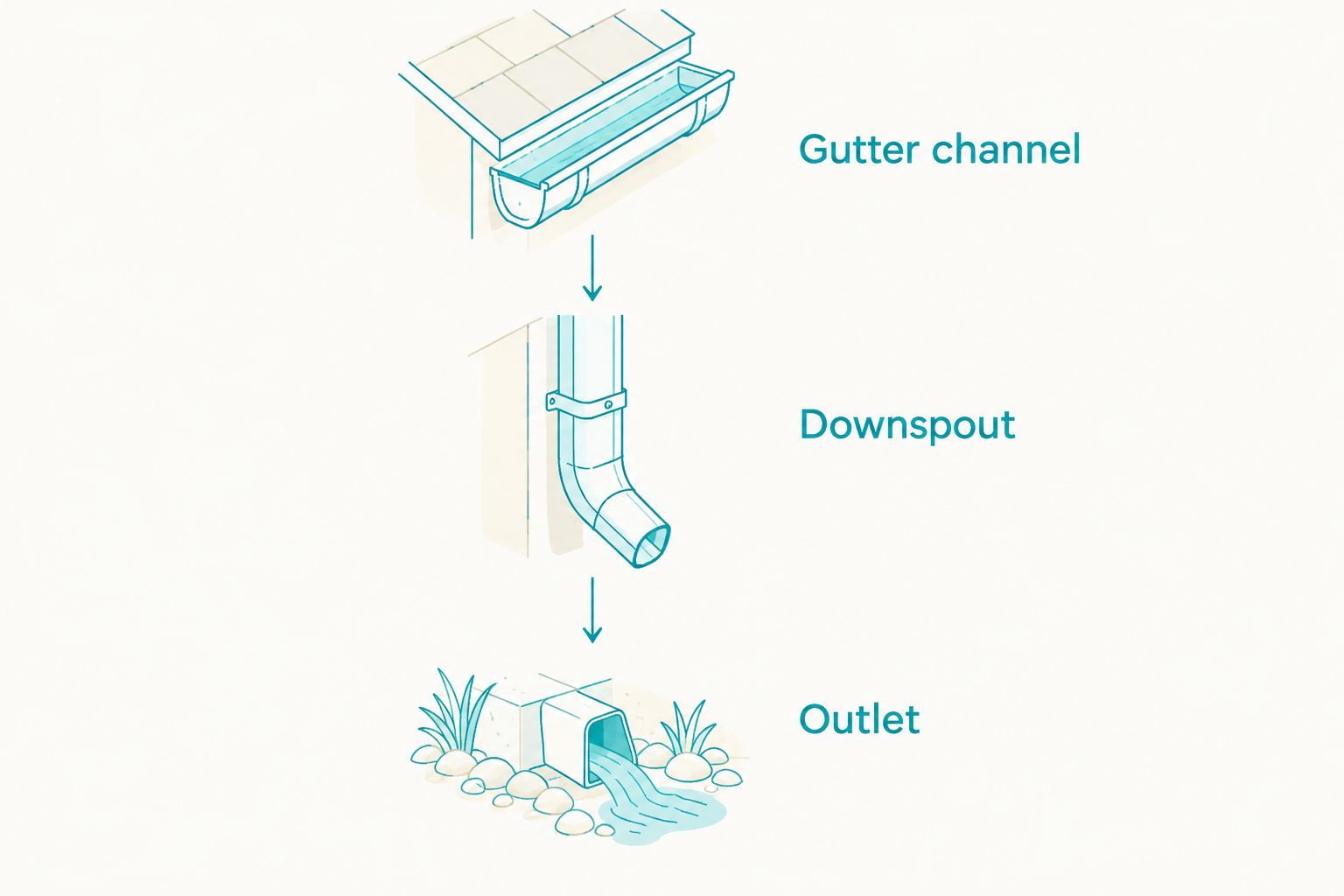
Treat hidden connections as questions, not conclusions. If a downspout enters an underground pipe, ask where that pipe leads and how its operation was checked.
- Look for visible material in the gutter channel.
- Check accessible downspout openings from a safe position.
- Identify where every visible outlet discharges.
- Mark concealed drainage connections for follow-up.
- Record standing water or overflow when observed safely.
3. Choose access based on the house, not convenience
Begin with observation and paperwork rather than equipment. If debris is beyond safe reach, stop the homeowner inspection there. Wet ground, narrow side yards, sloping landscaping, and roof height all affect access.
Do not turn a new-home maintenance task into a roof-access experiment. A tall extension tool does not establish that you can see the blockage, remove it completely, or inspect the outlet. Roof walking also introduces a separate risk of damaging unfamiliar roofing materials.
Professional cleaning is the next option when access or blockage location is unclear. Ask Lavarecleans to assess the property in person and explain the proposed work. The benefit is having a local crew assess the job; the limitation is that cleaning alone does not resolve an installation defect.
For upper-level rooflines, review the gutter-cleaning methods for two-story Ventura homes before discussing access.
- Describe upper-level gutters when requesting a quote.
- Point out slopes, narrow paths, and delicate landscaping.
- Ask how the crew will reach each gutter section.
- Keep children and pets away from the work area.
- Leave inaccessible debris for a properly equipped professional.
4. Agree on debris removal and flow checks
Write a short scope before work begins. Separate removing material from checking water movement, cleaning exterior gutter faces, and investigating underground drainage. Those are different tasks; do not rely on the phrase gutter cleaning to define all of them.
Ask how loose construction material will be collected rather than washed into a downspout. If the crew finds attached roofing material, a displaced fitting, or something that appears to be part of the installation, pause for identification. Removing the wrong component is not cleanup.
A controlled flow check should follow debris removal where appropriate for the system and site. Ask what the check establishes and what remains concealed. Do not treat visible discharge as certification of every hidden connection.
- Specify which gutter runs and downspouts are included.
- Ask for loose debris to be collected and removed.
- Identify attached or unfamiliar material before disturbing it.
- Clarify whether flow checks are included.
- Separate exterior washing from internal debris removal.
- Agree on how inaccessible sections will be reported.
5. Separate cleaning findings from installation repairs
After cleaning, review what changed. If water still stands in a gutter or overflows at the same location, take the finding back to the builder or the appropriate installer. More cleaning is not automatically the answer.
A clear gutter cannot correct its own slope, reconnect a loose joint, or finish an incomplete drainage connection. Ask for observations in plain language rather than accepting a diagnosis based only on where a stain appears.
Keep 2 records: the condition before cleaning and the condition afterward. These are documentation sets, not a substitute for an inspection. Their value is showing what was visible and what work occurred between the observations.
- Save before-and-after photographs together.
- Note which material was removed and from where.
- Record any section that could not be reached.
- Send continuing drainage concerns to the builder.
- Request a separate repair scope when a defect is identified.
6. Set a maintenance plan around actual conditions
Start with a clean baseline, then adjust to what your property collects. A home near mature trees has different exposure from an open lot. Ongoing construction nearby is another reason to look again after the initial handover cleanup.
Use your 2026 maintenance calendar to record observations rather than assign an unsupported universal interval. Check from the ground after substantial nearby work and when rain reveals a drainage problem. Follow the builder's and gutter manufacturer's maintenance instructions.
Coordinate other exterior services without treating them as interchangeable. Window cleaning remains a year-round task; gutter checks become especially useful before wet weather. Solar panel cleaning, pressure washing, and holiday lighting each need their own agreed scope and access plan.
- Record the date and scope of the initial cleaning.
- Recheck after roofing or exterior construction work.
- Note debris patterns near trees and exposed roof corners.
- Review gutter condition before seasonal lighting work.
- Keep window, solar, and washing tasks separately defined.
Request a gutter-cleaning quote
Ask the local crew for a free in-person quote for your Ventura home.
Compare your cleanup options
Choose by responsibility and access, not by who can arrive first. A builder, homeowner, and cleaning crew serve different roles. You can use more than one route without asking any of them to take responsibility for work outside the agreed scope.
| Option | Best for | Main advantage | Key limitation |
|---|---|---|---|
| Builder follow-up | Unfinished handover work or suspected installation defects | Keeps construction concerns with the responsible party | Scope depends on your agreement; routine maintenance is a separate question |
| Homeowner ground-level check | Documenting visible conditions before requesting help | Lets you gather photographs and identify questions without roof access | Cannot confirm concealed blockages or inspect every gutter section |
| Lavarecleans gutter cleaning | Ventura homeowners wanting a local crew and an in-person quote | Provides a direct way to discuss cleaning needs and careful work | Confirm the exact scope; do not assume repairs or underground drain work are included |
| Gutter or drainage installer | Persistent problems after accessible debris is removed | Addresses questions about installation and drainage layout | Does not replace routine debris removal unless that work is included |
When comparing written proposals, match the listed work before comparing the totals. One proposal might cover accessible channels only; another might include downspout checks and debris disposal. Ask each provider to state exclusions clearly.
Common mistakes new-home owners make
Assuming the final walkthrough covered the gutters
A walkthrough is not a record of every concealed surface. Ask specifically whether gutters and downspouts were checked, and request any available documentation. An attractive exterior is not evidence of unobstructed drainage.
Washing loose debris into the drainage system
Moving material out of sight is not the same as removing it. Collect accessible loose debris before an appropriate flow check. If a blockage is suspected farther downstream, identify the next inspection step rather than adding more water.
Treating every overflow as a cleaning problem
Debris is one possible cause, not a complete diagnosis. If overflow continues after cleaning, document where it happens and ask about the installation. Repeatedly booking the same task without reviewing the result leaves the underlying question unanswered.
Bundling exterior work without defining each task
A request to clean everything leaves too much open. Specify gutters, window glass, screens, solar panels, and ground surfaces separately where relevant. Do not assume a gutter-cleaning quote includes paint removal, mineral-deposit treatment, roof work, or repairs.
FAQ
Do brand-new Ventura homes need gutter cleaning?
Brand-new Ventura homes need their gutters checked for debris and drainage problems; cleaning is needed when material is present. New installation alone does not establish that channels, downspouts, and outlets are clear.
Should my builder clean the gutters before handover?
Check your construction agreement and handover scope to establish the builder's cleanup responsibilities. Ask for a written response about remaining debris and keep installation concerns separate from later maintenance.
Can I check my new gutters without climbing a ladder?
You can document visible conditions from the ground, including outlets, overflow, and some roof-edge debris. Ground-level observation cannot confirm that concealed sections or underground connections are clear.
Is professional gutter cleaning better than doing it myself?
Professional cleaning is the better choice when gutter access or blockage location is beyond your safe reach. Ask how the work will be performed and which sections the proposed scope covers.
Will cleaning fix water standing in a new gutter?
Cleaning resolves standing water only when removable debris is the cause. If water remains after the channel is clear, ask the builder or installer to assess the gutter's slope and connections.
How often should I clean gutters on a new Ventura home?
Set the schedule using the manufacturer's instructions and the debris your property actually collects. Recheck after nearby construction work and use observed conditions to decide when another cleaning is needed.
Can I request window cleaning with gutter cleaning?
You can ask Lavarecleans about window cleaning and gutter cleaning in the same quote request. Have each service listed separately so glass, screens, gutter debris, and flow checks are not confused.
One last thing
The most useful first gutter visit creates a baseline, not just an empty channel. Before closing your 2026 handover file, save the cleaning scope, photographs, and any unresolved drainage questions together. Then you have something concrete to refer to when conditions change.