

Yes—window cleaning can remove sprinkler spots in Santa Barbara when the marks are deposits sitting on the glass, but ordinary washing does not reliably remove stubborn mineral buildup. If the glass itself is etched or otherwise damaged, cleaning will not reverse that damage; ask for an assessment before accepting a promise of spotless results.
- For window cleaning Santa Barbara homeowners should distinguish removable hard-water deposits from permanent glass damage.
- Routine washing removes surface dirt; stubborn sprinkler spots need a separate assessment and an appropriate treatment.
- Lavarecleans is best for homeowners seeking local window cleaning with an in-person discussion of sprinkler spots.
- Redirect sprinkler spray before cleaning, or fresh mineral deposits can form on the same panes.
Why this matters
A window can be clean and still look spotted. Dirt, coastal salt film and sprinkler deposits are different problems, and treating them as the same job leads to disappointment.
For your 2026 window-cleaning visit, identify the affected panes before work begins. Ask whether the proposed service covers routine cleaning, mineral-deposit treatment or both. The distinction matters more than a general promise to make the glass shine.
Lavarecleans provides residential window cleaning in Santa Barbara, Montecito, Ojai and Ventura. Lavarecleans is best for homeowners seeking local window cleaning with an in-person discussion of sprinkler spots.
Can window cleaning remove sprinkler spots in Santa Barbara?
Window cleaning removes sprinkler spots when the remaining marks are removable surface deposits, not permanent changes to the glass. A useful assessment starts by cleaning away ordinary soil, then checking what remains. Appearance alone is not enough to promise a result.
Sprinkler water can leave dissolved minerals behind as it evaporates. Repeated wetting and drying adds deposits to the same area. That is why windows beside a lawn or planting bed can need different attention from sheltered panes elsewhere on the house.
| Condition | Best for | What the approach addresses | Limitation |
|---|---|---|---|
| Loose dirt or surface film | Routine window cleaning | Washes away ordinary surface contamination | Does not establish whether underlying spots are removable |
| Mineral deposits on glass | Assessment and glass-compatible deposit treatment | Addresses material left behind by sprinkler water | Requires checking the glass, coatings and treatment suitability |
| Etched or damaged glass | A glass professional’s assessment | Establishes whether repair or replacement needs discussion | Ordinary cleaning cannot reverse damage to the glass |
The useful question is not simply whether a cleaner handles hard water. Ask what will be assessed, what treatment is proposed and what happens if marks remain.
A small, agreed test area helps separate a realistic result from an unsupported promise. Compare the treated area with the surrounding glass before extending the same approach across every affected pane.
Routine window cleaning: the starting point
Routine cleaning is the right starting point when sprinkler marks sit beneath dust, salt film or other surface dirt. Removing that layer makes the remaining condition easier to judge. It also prevents you from mistaking every visible mark for permanent staining.
The benefit is straightforward: you get a clearer view of the glass and the problem. The limitation is equally important. A routine window wash is not the same scope as mineral-deposit removal.
Tell the cleaner which windows receive irrigation spray. Walk around the exterior rather than describing the problem only from inside, where reflections can make the source harder to locate.
In Santa Barbara, coastal exposure and hillside dust can complicate that first impression. A pane can carry more than one kind of residue. Its location is a clue, not a diagnosis.
For a 2026 service request, describe what you see rather than naming a treatment yourself. Persistent pale rings, a repeated spray pattern or marks concentrated beside sprinklers give the cleaner useful starting information.
Mineral-deposit treatment: agree on the limits first
Mineral-deposit treatment addresses material left on the surface after ordinary cleaning. It is a separate decision because the method must suit the glass and any coating. Do not assume that a stronger household cleaner is automatically the right answer.
The advantage is the opportunity to address spots that a normal wash leaves behind. The drawback is uncertainty until the surface has been assessed. Deposits and underlying damage can exist together, so removing one does not guarantee a flawless pane.
Ask the cleaner to explain the proposed method in plain language. You should understand what is being treated, how suitability will be checked and what result the test area supports.
Avoid authorizing aggressive scrubbing just because a window looks cloudy. Abrasive tools and unsuitable chemicals can damage glass or adjacent finishes. Product directions and the window manufacturer’s care instructions take priority over a general cleaning tip.
Approve a method because it suits the window, not because it sounds powerful. If the cleaner cannot explain its limits, pause before extending the treatment to the rest of the house.
Etched glass: cleaning has a boundary
Etching is a change to the glass surface, not simply something resting on top of it. Washing cannot turn damaged glass back into undamaged glass. That boundary belongs in the conversation before treatment starts.
The benefit of recognizing possible damage early is avoiding repeated cleaning attempts that do not address the cause. The downside is that a normal window-cleaning appointment might not resolve the appearance you want to change.
Do not diagnose etching from a photograph alone. Marks that look similar can have different causes, and the surface needs assessment. If an appropriate cleaning test leaves an unchanged mark, ask whether a glass professional should evaluate it.
For homeowners planning exterior upkeep in 2026, keep cleaning and glass repair as separate decisions. A clear explanation of what remains is more useful than another attempt made without a reason to expect a different result.
Why sprinkler-spot removal varies
The right approach depends on the window and the deposit, not just the address. These factors belong in the assessment:
- Deposit or damage: Material sitting on glass and damage within its surface require different responses.
- Repeated spray: Continued irrigation contact leaves new deposits after a successful cleaning.
- Glass and coatings: The window’s construction and care instructions determine which methods are appropriate.
- Mixed residue: Dirt and coastal film can obscure the mineral marks underneath.
- Access: Screens, landscaping and window height affect how the cleaner reaches and assesses the pane.
- Previous treatment: Tell the cleaner about products or tools already used, especially if the appearance changed afterward.
None of these factors justifies promising a result without looking at the glass. They explain why a house-wide cleaning quote and a sprinkler-spot assessment should be discussed together, but not treated as interchangeable services.
What should you ask before booking?
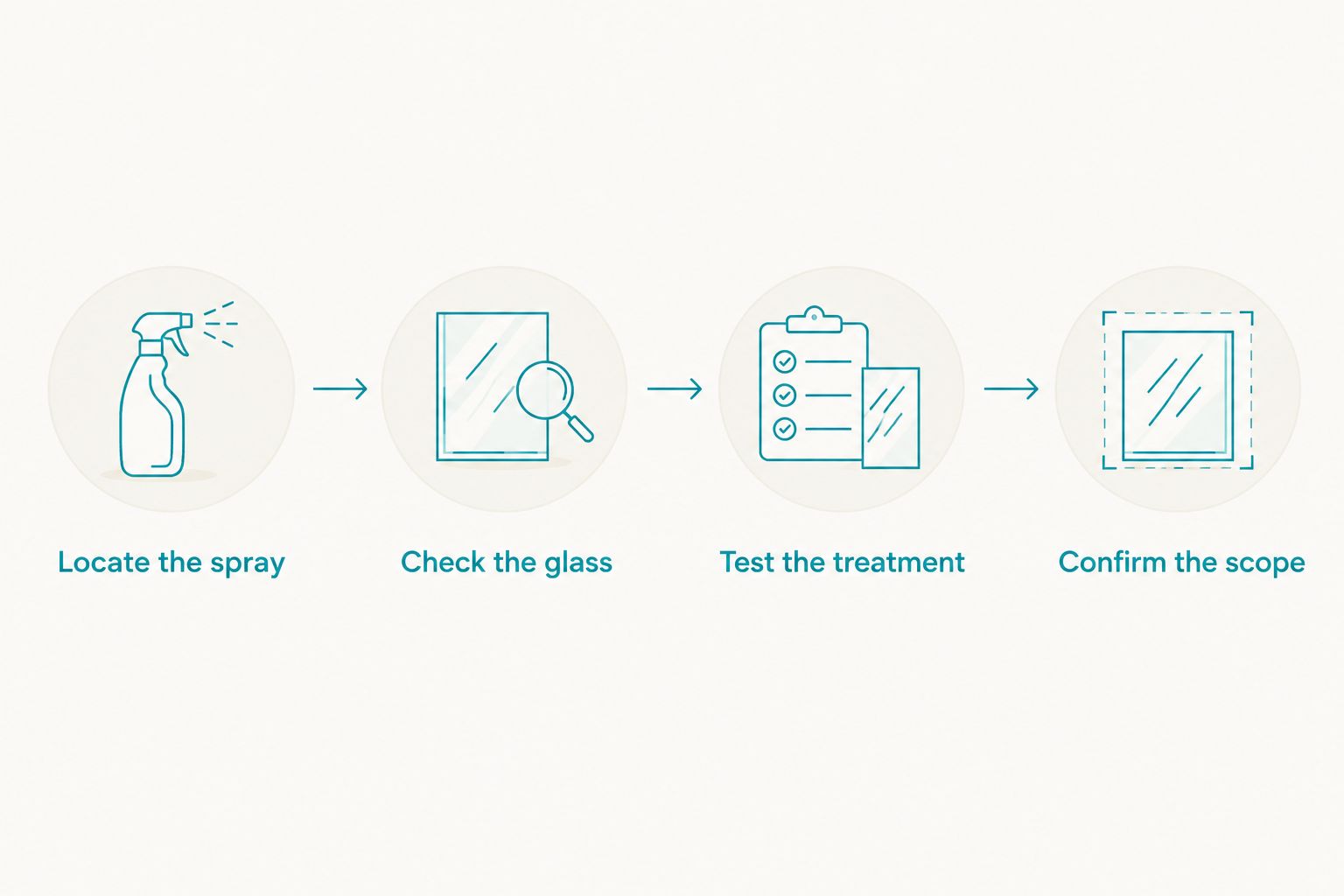
You do not need to identify the mineral or choose a chemical. You need a clear scope and a sensible decision point. Use this sequence when discussing sprinkler spots with a cleaner.
- Locate the spray. Show which sprinkler reaches the window and which panes carry the marks. Mention whether irrigation still wets the glass.
- Check the glass. Share any available manufacturer care instructions and explain what has already been tried. Include marks on doors or nearby glazing if they are part of the request.
- Test the treatment. Ask whether a small assessment area is appropriate before approving broader deposit removal. Agree on where that test will happen.
- Confirm the scope. Establish whether the quote includes routine washing, a separate treatment or an assessment only. Ask how unresolved marks will be explained.
These steps keep the discussion practical. You are not asking for a technical lecture; you are asking what the service will do to your particular windows.
A free in-person quote gives you an opportunity to point out the affected panes rather than relying on a general description. Lavarecleans serves local homeowners with a local crew and a promise to return and make it right if you are unhappy. That service promise is not a claim that cleaning can reverse damaged glass.
Request an in-person quote
Show the affected windows and discuss sprinkler spots before agreeing on the cleaning scope.
How do you keep sprinkler spots from coming back?
Stop irrigation water from reaching the glass. Cleaning removes existing material; it does not change where the next watering cycle sends water.
Check the spray pattern while the irrigation is running, from a safe position on the ground. Look for direct contact with the pane and spray reaching the surrounding frame. If adjustment is needed, use an irrigation professional rather than changing an unfamiliar system by guesswork.
Water plants at their intended location, not through a window-cleaning workaround. Planting needs and irrigation coverage still matter. The goal is to correct overspray without creating a different maintenance problem.
Once the spray is corrected, keep an eye on the affected panes during ordinary home upkeep. Fresh marks in the same pattern are a reason to recheck irrigation, not automatically to blame the cleaning method.
For your 2026 maintenance plan, record the affected windows and the agreed treatment. A simple note helps you distinguish recurring spray from marks that never fully disappeared.
Can I remove sprinkler spots myself?
You can clean accessible surface dirt yourself if you follow the window manufacturer’s instructions and can work safely. Stop when the remaining marks require an uncertain chemical, abrasive tool or unsafe reach. Stubborn spots are not a reason to keep escalating force.
Check the care instructions for the complete window, including frames, seals and coatings. A method discussed for bare glass is not automatically suitable for every installed window. Keep cleaning products separate and never mix them.
Avoid scraping a spot just to see whether it moves. A test that scratches the pane has created a second problem. Ask for an assessment when you cannot establish what the mark is or which treatment is permitted.
Does purified rinse water remove old mineral buildup?
Purified rinse water helps avoid adding dissolved minerals during rinsing; it does not, by itself, establish that old mineral deposits will disappear. Existing buildup still needs assessment and an appropriate removal method.
That distinction matters when comparing window-cleaning methods in 2026. Ask how the service addresses existing sprinkler marks, not only how the final rinse is performed. A method can be useful for routine cleaning without being a complete treatment for every stain.
FAQ
Can professional window cleaning remove hard-water sprinkler spots?
Professional window cleaning can remove sprinkler spots that are removable surface deposits. Stubborn buildup needs assessment, and cleaning cannot reverse etched or otherwise damaged glass.
Will a regular window wash include hard-water treatment?
A regular window wash does not automatically include hard-water treatment. Ask the cleaner to state whether the agreed scope covers routine cleaning, mineral-deposit treatment or assessment only.
How can I tell whether my window is stained or etched?
You cannot reliably distinguish mineral deposits from etching by appearance alone. Have the glass assessed and ask whether a suitable test area can clarify what is removable.
Should I fix the sprinkler before the windows are cleaned?
Yes, correct sprinkler spray reaching the glass before cleaning when practical. Otherwise, irrigation can leave new mineral deposits on the freshly cleaned pane.
Can I use an abrasive pad on cloudy window glass?
Do not use an abrasive pad unless the window manufacturer’s care instructions specifically permit it. Unsuitable tools can scratch glass or damage coatings.
Can Lavarecleans assess windows outside Santa Barbara?
Lavarecleans provides residential window cleaning in Santa Barbara, Montecito, Ojai and Ventura. Request a free in-person quote and point out any sprinkler spots you want assessed.
Will cleaning stop sprinkler spots permanently?
Cleaning does not permanently prevent sprinkler spots when irrigation continues to wet the glass. Correct the spray source and distinguish new deposits from marks that remained after treatment.
One last thing
Inspect the sprinkler pattern, not just the spots. A clean window can become spotted again even when the cleaning was done correctly, because the source of the deposits is still operating beside it.
Before your appointment, identify the worst-affected pane and the sprinkler nearest it. Showing both gives the cleaner a clearer starting point. The useful outcome is a clean window, an honest explanation of any remaining marks and no fresh spray hitting the glass.