
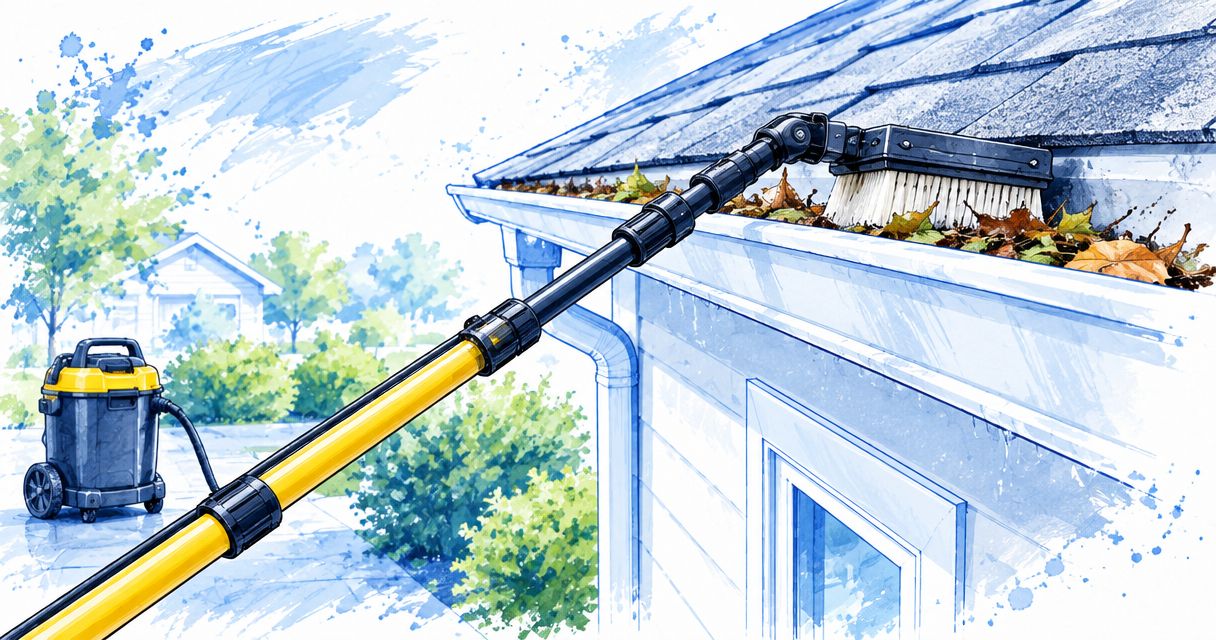
Yes, gutter cleaning without a ladder is possible with a gutter vacuum, a ground-operated blower attachment or a hose attachment, provided the tool can reach the debris safely. The limitation is inspection: removing visible leaves does not prove that the gutter outlet and downspout are clear. Choose the method around access, debris and a way to check drainage—not reach alone.
- Gutter cleaning without a ladder works only when you can reach debris and verify drainage.
- A gutter vacuum collects debris; blower and hose attachments require more control over where debris goes.
- Gutter guards, packed material and hidden blockages can prevent a ground-only clean.
- Lavarecleans offers local homeowners an in-person quote for gutter cleaning; confirm the proposed access method before booking.
Can gutter cleaning be done without a ladder?
Yes, but ground-operated tools must do more than reach the roofline. They need to remove the material causing the problem without damaging the gutter or pushing a blockage farther into the drainage system.
For homeowners considering Lavarecleans, a free in-person quote is the time to ask whether the whole job can be completed from the ground. A method that suits an open, accessible gutter does not automatically suit a covered gutter behind landscaping.
| Method | Best for | Main benefit | Main limitation |
|---|---|---|---|
| Gutter vacuum with extension poles | Collecting reachable, loose debris | Collects material rather than deliberately scattering it | Packed debris and restricted openings can prevent effective pickup |
| Blower with gutter attachment | Dry, loose leaves in open gutters | Moves lightweight material without climbing | Scatters debris and gives limited control near outlets |
| Hose with gutter attachment | Rinsing residual dirt after bulk debris removal | Helps check the path of water through the gutter | Adds water without necessarily removing a solid blockage |
These are method choices, not a promise that every property qualifies. For your 2026 maintenance plan, ask how the cleaner will inspect the gutter, remove debris and confirm the result.
Why this matters
A clean-looking gutter edge tells you little about what sits behind it. Leaves can collect around an outlet while the rest of the channel looks clear from below.
Around oak-shaded homes in Ojai or Montecito, the useful question is what has collected inside the gutter—not which attachment looks easiest to use. On a hillside property, stable ground and access along the wall also matter.
Keeping your feet on the ground removes the need to climb a ladder; it does not remove every hazard. Overhead electrical lines, falling debris, awkward poles and slippery footing still require attention. Never operate extension equipment near overhead electrical lines.
Gutter vacuum: best for collecting reachable debris
A gutter vacuum uses suction through extension poles to collect material from the channel. Its main advantage is control over the waste: leaves travel into a collection container instead of being blown across the garden.
The limitation is what the nozzle can actually reach and lift. A compacted layer, a lodged twig or a restricted opening can stop the tool from clearing the gutter properly. Suction at the nozzle does not establish that a downspout is open.
Ask how the operator checks the gutter before and after cleaning. A suitable inspection camera can help show the channel, but a view of the channel is not the same as a drainage check.
This method deserves consideration when you want debris collected and there is clear access for the poles. Do not accept the equipment name as proof of a complete clean; ask what happens if the nozzle cannot remove a blockage.
Blower attachment: best for dry, loose leaves
A blower attachment directs air into the gutter from below. It suits lightweight, dry material better than a wet layer pressed against the gutter floor.
Its drawback is straightforward: displaced leaves have to land somewhere. They can fall onto paths, outdoor furniture, planting beds or neighboring areas. Protecting those areas and collecting the scattered material belong in the job plan.
There is also a difference between moving debris out of the gutter and moving it toward an outlet. If material gathers at the outlet, the drainage problem remains even when the surrounding channel looks cleaner.
Choose this approach only when the operator can control the discharge and check what remains. Wind, nearby windows and people using the space below all affect whether blowing debris is a sensible choice.
Hose attachment: best for rinsing after debris removal
A hose attachment introduces water into the gutter from ground level. It can help rinse loose residue after leaves and other bulk material have been removed.
Water is a checking tool, not proof that a solid obstruction has disappeared. A jet can shift material toward a downspout without carrying it through. Overflow during rinsing calls for investigation rather than more water.
Watch the intended discharge point where it is accessible. Water leaving the gutter through a joint, spilling over an edge or backing up at an outlet is not a successful drainage result.
Do not substitute an improvised pressure-washer setup for a suitable gutter attachment. Keep the cleaning method appropriate to the gutter material, joints and surrounding surfaces, and follow the equipment instructions.
Why ladder-free gutter cleaning varies by home
The same attachment can work well on one gutter run and fail on another. These factors determine whether ground-only cleaning is practical:
- Access: Walls, planting beds, patios and slopes affect where the operator can stand and move.
- Debris condition: Loose leaves behave differently from damp, compacted material or lodged branches.
- Gutter guards: A cover can block the cleaning head or require removal before the channel is accessible.
- Gutter layout: Corners, roof projections and concealed sections can restrict the tool's working angle.
- Downspout route: An accessible outlet is easier to check than a concealed connection or underground drain.
- Gutter condition: Loose joints, sagging sections and damaged components need assessment rather than forceful cleaning.
For a taller property, read the guide to gutter cleaning methods for two-story Ventura homes. Height is part of the decision, but access and verification matter just as much.
How do you check whether a ground-only clean is suitable?
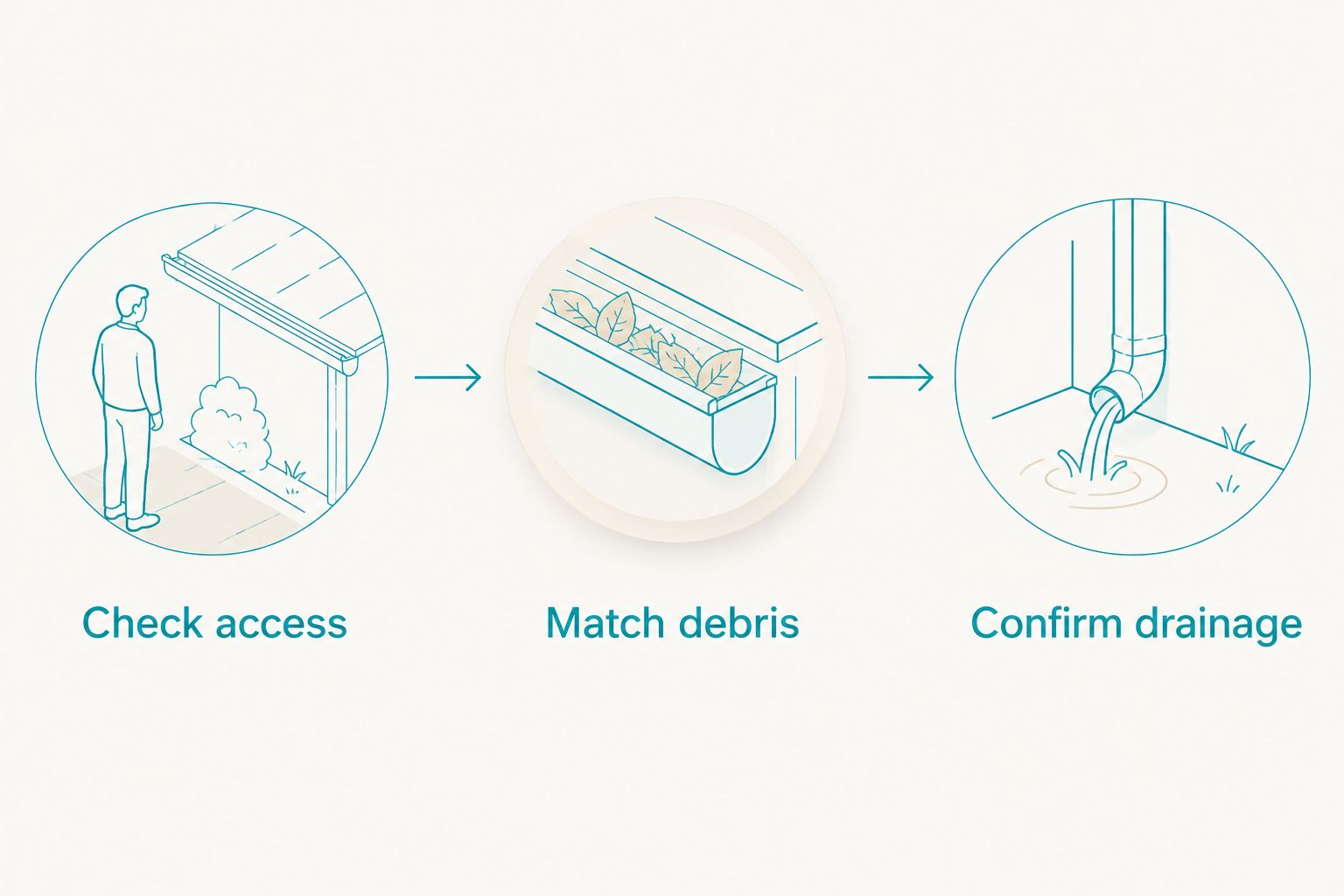
Use 3 checks before choosing a method: access, debris and drainage. In 2026, the useful booking question is still practical: “How will you know the gutter is clear?”
Check access
Look from a safe position on the ground. Note sloping surfaces, overhead wires, narrow side yards and anything that prevents a clear working position.
Tell the cleaner about fragile planting, enclosed courtyards and areas that are difficult to reach. Do not climb onto furniture, walls or improvised platforms to make an attachment reach farther.
Match debris
Describe what you can see without guessing about hidden sections. Loose leaves, plants growing from the gutter and water overflowing at a corner describe different problems.
Ask which tool suits the observed material and what happens if the first method cannot remove it. A sensible plan includes stopping and reassessing rather than forcing a pole or adding more water.
Confirm drainage
Ask how the cleaner will check both the channel and the downspout. If a discharge point is hidden or connected underground, agree on the inspection limits before work begins.
The completion standard should describe what was cleared and what was checked. “The attachment reached the gutter” is not a completion standard.
When should you stop trying to clean from the ground?
Stop when you cannot see or verify the result, when the tool catches, or when the work requires an unstable stance. Pulling harder on a stuck attachment risks damaging the gutter or losing control of the pole.
A persistent overflow also deserves a closer look. Debris is not the only explanation: a damaged section, an outlet problem or a drainage defect can remain after cleaning.
Do not turn “without a ladder” into a requirement that prevents proper inspection. Ask a professional to assess the access method when guards need removal, a blockage remains hidden or gutter components need attention. That assessment should establish the safe approach rather than assume ladder access is automatically suitable.
You do not need to diagnose the repair yourself. Identify where the water behaves unexpectedly and describe it clearly.
What should you ask before booking gutter cleaning?
Ask 4 questions before approving your 2026 gutter-cleaning quote. They separate the cleaning task from assumptions about equipment and results.
- What does the cleaning include? Confirm debris removal, outlet attention and whether downspout checking forms part of the scope.
- How will you access each section? Ask whether the proposed ground-operated method reaches the entire gutter or only selected runs.
- How will you confirm the result? Request a clear explanation of inspection and drainage checking, including anything that cannot be verified.
- What happens if you find a blockage or damage? Establish when work pauses, how you are informed and what needs separate approval.
Lavarecleans is best for local homeowners who want an in-person assessment before booking gutter cleaning. Its local crew serves Santa Barbara, Montecito, Ojai and Ventura, and its promise is to return and make it right if you are unhappy.
That does not mean every gutter can be cleaned entirely from below. Request a free in-person quote and ask which access method fits your home, rather than requesting a particular tool before the gutter has been assessed.
Can gutter cleaning without a ladder clear a blocked downspout?
Ground-operated cleaning can remove reachable material at an outlet, but it does not establish that a blockage farther down the pipe has cleared. The result depends on where the obstruction sits and whether it can be reached and removed.
Treat the job as 2 parts: debris removal and drainage verification. A clean channel with a blocked downspout is unfinished drainage work, even if the visible leaves are gone.
Does a gutter guard make ground-level cleaning easier?
A gutter guard can prevent a vacuum nozzle or other attachment from reaching the channel beneath it. The guard's design and condition determine whether cleaning is possible without opening or removing it.
Do not bend or pry a cover with an extension tool. Ask how the guard will be handled and whether removal and refitting are included before work starts.
Is ground-level cleaning enough before the rainy season?
Ground-level cleaning is enough only when it removes the relevant debris and leaves drainage checked within the agreed scope. The calendar does not make an incomplete clean adequate.
For your 2026 pre-rain visit, explain any previous overflow and identify its location. A photo taken safely from indoors or the ground during rain can help show the symptom, but do not stand beneath active overflow to document it.
FAQ
What's the best way to clean gutters without a ladder?
The best method depends on access and debris: a gutter vacuum collects reachable material, a blower moves dry leaves, and a hose rinses residue. Choose a method that also allows inspection and drainage checking.
Can I clean upstairs gutters while standing on the ground?
Upstairs gutters can be cleaned from the ground only when suitable equipment reaches them safely and allows the result to be checked. Height alone does not establish safe access.
Will a garden hose clear a clogged gutter?
A garden hose does not reliably remove a solid gutter blockage. Remove bulk debris before rinsing, and stop if water backs up or overflows.
Is gutter cleaning without a ladder completely safe?
Gutter cleaning without a ladder is not risk-free. Falling debris, overhead electrical lines, unstable footing and difficult-to-control poles remain hazards.
Can gutters be cleaned from below when they have guards?
Gutters with guards can be cleaned from below only if the guard permits suitable access. Some covers need removal before the channel can be cleaned properly.
What should a gutter cleaner check after removing leaves?
A gutter cleaner should check the channel, outlet and accessible drainage route within the agreed scope. Ask for a clear explanation of any concealed sections that remain unverified.
Can I request a local in-person gutter-cleaning quote?
Lavarecleans offers free in-person quotes for homeowners in Santa Barbara, Montecito, Ojai and Ventura. Ask whether ground-only cleaning suits your gutter layout and what the proposed scope includes.
One last thing
Before your next 2026 gutter-cleaning visit, locate the downspout discharge points you can see safely from the ground. Show them to the cleaner and point out any that disappear underground.
The most useful question is not whether the leaves are gone. It is where the water goes next. That keeps the conversation focused on a working drainage path rather than a preferred piece of equipment.