
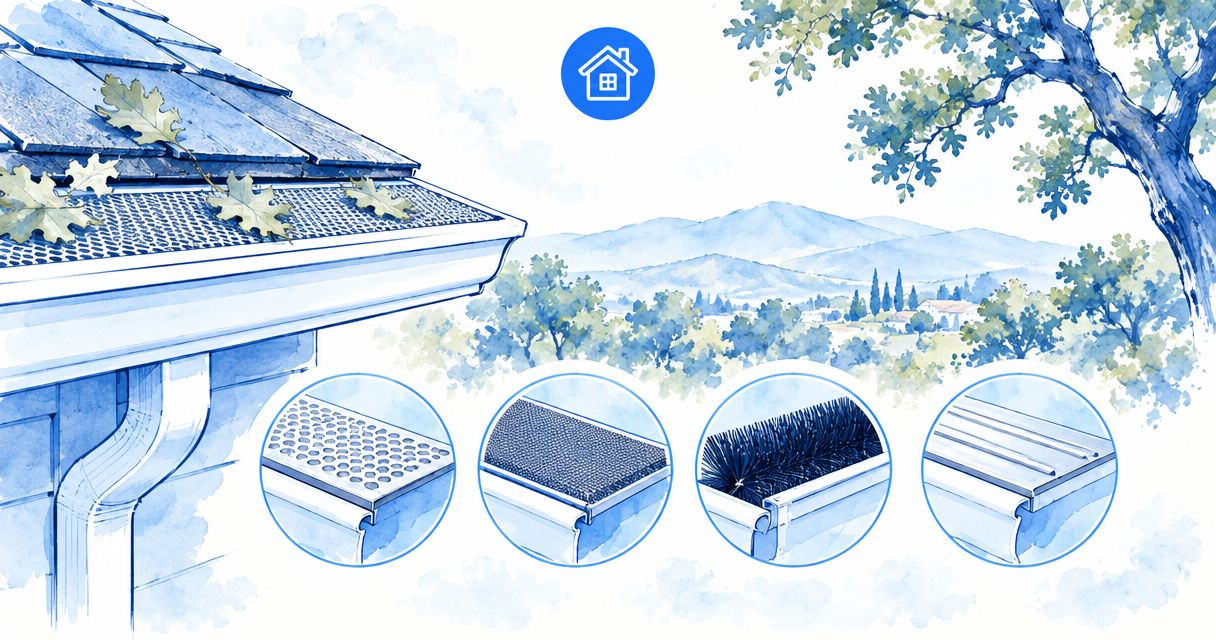
Best overall for oak-shaded Ojai homes: fine micro-mesh guards. Best for larger leaves: perforated metal guards. Best simple alternative: coarse-screen guards. This 2026 guide compares five gutter guard types by the debris they exclude, how they drain, and the cleaning access they leave behind.
- Fine micro-mesh leads the best gutter guard types for Ojai homes with oak leaves and small debris.
- Perforated metal suits larger leaves, but smaller material can pass through its openings.
- Reverse-curve guards need careful roof-edge matching; foam inserts are a poor default beneath overhanging oaks.
- Gutter guards reduce some debris entry, not the need to inspect gutters and downspouts.
Why this matters beneath Ojai oaks
A gutter cover has two jobs: keep unwanted material out and let roof runoff in. Oak leaves, small plant fragments, and hillside dust make that a harder balance than simply stopping a handful of large leaves.
Lavarecleans gutter cleaning is best for Ojai homeowners who want local help clearing gutters before choosing a guard. The local crew provides residential exterior cleaning and promises to return and make it right if you are unhappy. Request a free in-person quote through Lavarecleans to discuss the cleaning work your home needs.
Choose the guard after checking the gutter underneath it. Covering a blocked outlet or an incorrectly draining gutter does not fix the drainage problem.
What makes the best gutter guard for an Ojai home?
Use these five criteria for your 2026 shortlist. A guard that wins on debris exclusion but makes servicing difficult is not an automatic winner.
- Debris exclusion: Match the openings to the material actually collecting in your gutters, including small fragments rather than leaves alone.
- Water entry: Examine how runoff reaches the gutter. A covered opening still needs an unobstructed route for water.
- Cleaning access: Ask how the cover opens or comes off when the gutter or outlet needs attention.
- Roof-edge fit: Check the relationship between the roof covering, drip edge, gutter, and proposed attachment method.
- Surface maintenance: Find out how leaves and sediment will be removed from the top of the guard.
Ask the installer to explain these points at your roof edge, not just on a display sample. Corners, roof valleys, and downspout locations deserve particular attention because they change where water and debris collect.
Gutter guard types at a glance
These are category-level comparisons, not endorsements of a particular manufacturer. Opening size, attachment details, and construction vary within each type.
| Rank and type | Best for | Standout feature | Key limitation |
|---|---|---|---|
| 1. Fine micro-mesh | Mixed oak debris and small fragments | Fine filtering surface over the gutter | Surface buildup can obstruct water entry |
| 2. Perforated metal | Predominantly larger leaves | Rigid cover with punched openings | Small debris can pass through |
| 3. Coarse screen | Broad leaves with straightforward access | Open mesh that intercepts larger material | Poor exclusion of smaller fragments |
| 4. Reverse curve | A roof edge suited to a shaped cover | Directs water around an edge into a slot | Performance depends on fit and an open entry path |
| 5. Foam insert | Temporary, removable debris interception | Fits inside the gutter channel | Debris can collect on and within the insert |
1. Fine micro-mesh: best for mixed oak debris
Fine micro-mesh guards place a closely woven screen above the gutter channel. Their smaller openings exclude more small material than a coarse screen, which makes them the strongest starting point beneath overhanging oaks.
The trade-off sits on top. Leaves, dust, and fine organic material can accumulate on the filtering surface instead of inside the gutter. That surface still needs attention when buildup interferes with water entry.
Fine micro-mesh pros:
- Intercepts both larger leaves and smaller plant fragments.
- Keeps more small debris out than a screen with wider openings.
- Leaves the gutter channel beneath a separate filtering surface.
Fine micro-mesh cons:
- Fine buildup can obstruct the filtering surface.
- Fastened covers can complicate access to the gutter below.
- A poor roof-edge fit still creates drainage problems.
Best for: Oak-shaded homes where the debris includes more than intact leaves.
For a 2026 installation, ask to see how the proposed guard is removed for gutter servicing. Also ask how the installer addresses runoff at roof valleys; the mesh alone does not answer that question.
Verdict: Buy fine micro-mesh when the fit, cleaning access, and surface-maintenance plan are clear.
2. Perforated metal: best for larger leaves
Perforated metal guards use punched openings in a rigid cover. They intercept leaves larger than those openings while allowing water and smaller material through.
This is a sensible alternative when larger leaves dominate the debris you find. Inspect the gutter contents first: a pile of leaf fragments and sediment calls for a different filtering decision than a channel filled mostly with whole leaves.
Perforated metal pros:
- Intercepts larger leaves above the gutter channel.
- Provides a rigid covering surface.
- Makes the opening pattern easy to inspect before choosing.
Perforated metal cons:
- Smaller debris can enter through the holes.
- Material resting over the openings can restrict water entry.
- Interior cleaning depends on how the cover is attached.
Best for: Homes where broad leaves are the main obstruction and smaller debris remains manageable through cleaning.
Compare the actual hole size rather than the words on the package. Perforated guards are not all equivalent filters, and a rigid panel is not proof that the whole installation will drain correctly.
Verdict: Buy perforated metal for larger-leaf interception; skip it if small debris is the main problem.
3. Coarse screen: best for straightforward leaf interception
Coarse-screen guards stretch an open mesh across the gutter. They stop material larger than the openings while allowing smaller fragments into the channel.
Their appeal is a straightforward filtering approach, not complete debris exclusion. Cleaning access depends on the fastening method, so do not assume every screen lifts out easily.
Coarse-screen pros:
- Intercepts broad leaves before they enter the gutter.
- Offers an opening pattern you can examine directly.
- Can provide accessible servicing when the attachment allows removal.
Coarse-screen cons:
- Small oak debris passes through wider openings.
- Leaves and twigs can catch in the screen.
- The gutter underneath still requires inspection.
Best for: Homeowners primarily dealing with large leaves who accept continued interior gutter cleaning.
For an oak-shaded property, compare a sample screen with the debris removed during cleaning. If much of that debris fits through the openings, the screen does not address your main obstruction.
Verdict: Hold until the opening size matches your debris; skip coarse screens for fine-fragment control.
4. Reverse curve: best for a compatible roof edge
Reverse-curve guards use a shaped cover to guide water around an edge and into an opening. Larger leaves are intended to continue over the outside rather than enter the gutter.
The design depends on the installed geometry and a clear water-entry path. Treat it as a roof-edge system, not a universal lid that works the same way on every house.
Reverse-curve pros:
- Separates larger leaves from water using a shaped surface.
- Covers much of the open gutter channel.
- Offers an alternative to a mesh filtering surface.
Reverse-curve cons:
- Small debris can enter through the intake opening.
- The intake and gutter interior still need servicing access.
- Fit and runoff behavior require careful assessment.
Best for: Homes where an installer can explain the roof-edge fit and demonstrate a practical maintenance method.
Ask what happens at corners and beneath roof valleys. Ask how a blocked intake will be reached without damaging the cover. A cutaway sample helps explain the design, but your actual roof edge determines whether it belongs on the shortlist.
Verdict: Hold until the installer resolves fit, concentrated runoff, and cleaning access.
5. Foam inserts: best for temporary, removable interception
Foam inserts occupy the gutter channel and allow water to move through their porous structure. Leaves rest above the insert rather than falling into an open channel.
That arrangement also places filtering material inside the drainage space. Organic debris can collect on and within the foam, so removal and cleaning remain part of the job.
Foam insert pros:
- Intercepts larger material above the gutter channel.
- Uses an insert rather than an external cover.
- Allows direct inspection after the insert is removed.
Foam insert cons:
- Debris can lodge within the porous material.
- The insert occupies space inside the gutter.
- Cleaning requires handling the insert as well as the channel.
Best for: A temporary, removable approach where regular inspection is already planned.
Beneath overhanging oaks, foam is not the default recommendation. It adds another material to clean in the same channel you need to keep clear.
Verdict: Skip foam as the default long-term choice for an oak-shaded Ojai home.
Check the drainage path before choosing
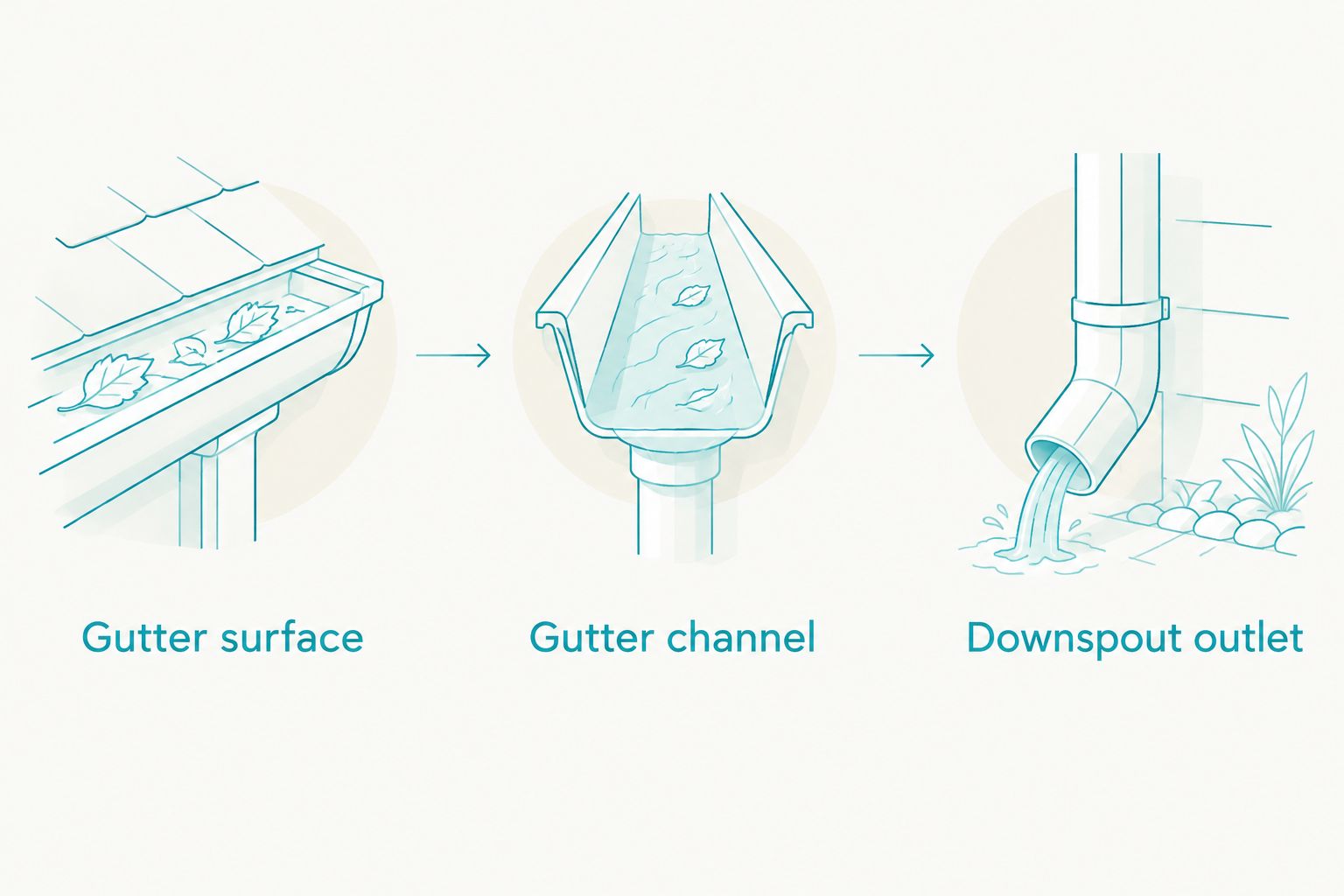
Before ordering guards in 2026, have the drainage route checked at 3 inspection points. These checks separate a filtering problem from a blockage or drainage problem.
- Gutter surface: Identify what lands on the roof edge and what would sit on top of a guard.
- Gutter channel: Check for existing debris, standing water, and sections that do not drain toward an outlet.
- Downspout outlet: Check the entrance, downspout, and discharge route for obstructions.
A guard changes where debris collects. It does not remove the need for a clear route from roof edge to discharge.
Keep observations from those checks with your quote. An accessible gutter with whole leaves presents a different maintenance task from a covered gutter with sediment around the outlet.
How the gutter guard types rank
The ranking favors small-debris exclusion first, then water entry, cleaning access, roof-edge fit, and surface maintenance. That places fine micro-mesh first for mixed oak debris, with perforated metal as the larger-leaf alternative.
This is a comparison of design trade-offs, not a measured product trial. No category earns a maintenance-free recommendation. Read the explanation of whether gutter guards eliminate gutter cleaning before treating a cover as a replacement for servicing.
Which gutter guard should you choose?
Start with fine micro-mesh, but approve the installation details before approving the guard. Choose perforated metal instead when larger leaves dominate and you accept that smaller material will enter.
For your 2026 decision, ask 2 service questions: How will the gutter be cleaned beneath the guard? Who will handle that work? Clear answers matter more than a claim that leaves simply slide away.
Lavarecleans gutter cleaning gives Ojai homeowners a way to address existing debris before deciding on covers. The exterior cleaning services also include windows, solar panels, pressure washing, and holiday lighting; a guard installation service is not part of this recommendation.
Request a gutter-cleaning quote
Arrange a free in-person quote for gutter cleaning at your Ojai home.
FAQ
What's the best gutter guard type for an Ojai home under oak trees?
Fine micro-mesh is the strongest starting point for mixed oak leaves and small fragments. Check roof-edge fit and cleaning access before selecting an installation.
Are micro-mesh gutter guards better than perforated metal?
Micro-mesh is better for excluding smaller debris; perforated metal suits larger-leaf interception. Both require attention when material collects over their water-entry openings.
Do gutter guards stop all gutter cleaning?
No. Guards collect debris on their surfaces, and smaller material can still reach the gutter depending on the design. Gutters and downspouts still need inspection.
Should I clean my gutters before installing guards?
Yes. Clear existing debris and check the drainage route before covering the gutter. A guard does not correct an obstructed outlet or a gutter that drains poorly.
Are foam gutter inserts a good choice beneath oak trees?
Foam inserts are not the default recommendation beneath overhanging oaks. Debris can collect on and within the insert, adding another component to remove and clean.
Can gutter guards fix water overflowing at a downspout?
A gutter guard is not a fix for a blocked downspout. Check the outlet, downspout, and discharge route before deciding whether a guard addresses the actual problem.
Can I request gutter cleaning without choosing guards first?
Yes. Lavarecleans provides gutter cleaning for Ojai homeowners and invites requests for a free in-person quote. Choosing a guard is a separate decision from clearing the existing drainage route.
One last thing
The useful clue is often in the debris removed from your gutter, not on a guard display. Ask to see whether it consists mainly of whole leaves, small fragments, or sediment. For your 2026 shortlist, match the filter to that material—and keep a practical way to reach the gutter underneath.